Ground in the Cylinder is Difficult Terrain. When a creature enters the Cylinder for the first time on a turn or starts its turn there, it must succeed on a Dexterity saving throw or have the Prone condition and lose Concentration.
Casting Time: Action
Range: 150 feet
Components: V, S, M (a miniature umbrella)
Duration: Concentration, up to 1 minute
School: Level 3 Conjuration
Who can cast Sleet Storm? Druids, Sorcerers, and Wizards have Sleet Storm on their class spell lists. Tempest Clerics (PHB 2014, pg. 62) and Circle of the Land (Polar) Druids (PHB 2024, pg. 84) get Sleet Storm for free and always have it prepared. Fathomless Warlocks (TCOE, pg.782, and Genie Warlocks (Marid) (TCOE, pg. 73) have Sleet Storm on their expanded class spell lists.
| Category | Score |
|---|---|
| Combat Rating | 9/10 |
| Exploration Rating | 2/10 |
| Social Rating | 1/10 |
| Raw Power | 8/10 |
| Versatility | 7/10 |
| Efficiency | 7/10 |
| Upcast Scaling | 1/10 |
Learn more about how my spell rating system works
Sleet Storm 5e
Sleet Storm has undergone a radical redesign in the 2024 update. While it physically covers less ground than its 2014 predecessor, it has become significantly taller and, more importantly, much more dangerous to enemy spellcasters.
The rules for maintaining Concentration in this storm have changed from a Constitution save to a Dexterity save. Below, I analyze why this change makes Sleet Storm the premier “Mage Slayer” spell of Tier 2 play and explain how the new area of effect changes your tactical placement.
What Does Sleet Storm Do in 5e?
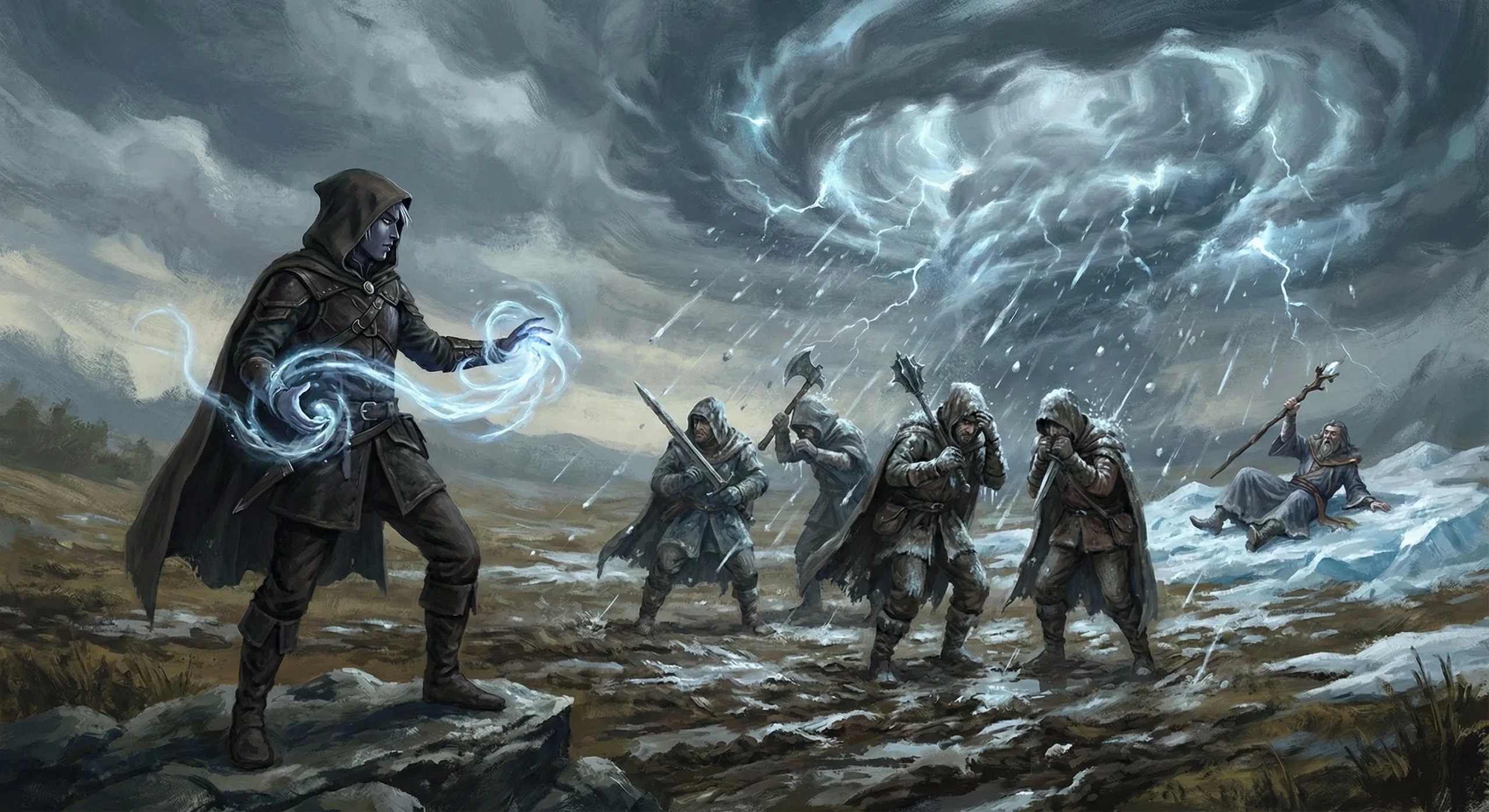
Sleet Storm creates a 40-foot tall, 20-foot radius Cylinder of ice and rain. This area has the following effects:
- Heavily Obscured. Creatures cannot see through the area, and creatures inside have the Blinded condition. This shuts down any spell requiring “a target you can see.” It also has other effects, which I’ll get into below.
- Difficult terrain. Movement costs 1 extra foot for every foot moved (PHB 2024, pg. 24).
- Fire dousing. Exposed flames are doused.
- The “slip” mechanic. When a creature enters the area or starts its turn there, it makes a Dexterity saving throw. On a failure, two things happen:
- It has the Prone condition:
-
Prone creatures can only crawl to move; crawling costs +1 speed per foot movement (yes, this does stack with the difficult terrain modifier).
-
Standing from prone costs half a creature’s movement speed.
-
A prone creature has disadvantage on attack rolls.
-
Attacks within 5 feet of the prone creature have advantage; attacks from more than 5 feet away have disadvantage.
-
- It immediately loses Concentration.
- It has the Prone condition:
How did Sleet Storm change in the 2024 PHB?
The 2024 version of Sleet Storm received significant mechanical adjustments compared to the 2014 version:
- Area of effect shrink: The radius was reduced from 40 feet to 20 feet. It now covers 8 squares across rather than 16 squares across. That’s about 52 total squares affected, rather than the 190-200 in the 2014 version of the spell (but that’s not a bad thing; friendly fire made it nigh-unusable in some environments in 2014.
- Height increase: The Cylinder is now 40 feet tall (previously 20 feet), making it much better at catching low-flying enemies.
- Concentration mechanic overhaul: In 2014, creatures made a Dex save to avoid falling Prone, and a separate Constitution save to keep Concentration. In 2024, these are linked. If you fail the Dex save, you automatically lose Concentration. No Constitution save is allowed.
Spell Rating: Sleet Storm
Overall: ⛈️ A-Tier (Caster Bane)
Contextual Performance (1-10)
-
Combat: 9/10. This is one of the best control spells in the game. By making the area Heavily Obscured, you prevent enemy casters from targeting your party with many spells (like Hold Person) or even escaping with Misty Step. By forcing a Dexterity save to maintain Concentration, you target a stat that most casters are bad at.
You also get attack advantage when you target a prone creature from 5 feet away, so your melee allies’ damage gets boosted (if they don’t mind entering the snow storm).
-
Exploration: 2/10. It puts out fires. That is essentially its only non-combat use.
-
Social: 1/10. Summoning a freezing ice storm is not a great way to make friends. Maybe you can convince some rubes that you control the weather, but don’t count on using Sleet Storm to solve social encounters.
Core Metrics (1-10)
-
Raw Power: 8/10. It deals 0 damage, but its power lies in action denial. If an enemy falls Prone in Difficult Terrain, standing up costs half their speed. With the remaining speed halved by Difficult Terrain, they are essentially stuck. If that enemy was concentrating on a spell, that spell is gone instantly.
-
Versatility: 7/10. It works on flying enemies (knockdown), spellcasters (concentration break), ranged attackers (can’t see through it and have to guess where to attack) and melee hordes (slow/prone). The reduced radius actually helps its versatility, as it is now easier to place in smaller dungeon rooms without hitting your own party.
Bonus points: I like powerful utility spells that aren’t just “DPR goes brr” or “Hypnotic Pattern goes night-night.” I’m running a Druid right now, and I have to say, Sleet Storm is one of the most fun and satisfying spells to use in my arsenal.
It feels like a real problem-solver that requires teamwork and a good sense of the environment to maximize its power — exactly what creative, memorable combat encounters are all about.
-
Efficiency: 7/10. For a 3rd-level slot, ending a powerful enemy concentration spell (like Dominate Person) while simultaneously trapping the caster is pretty efficient. Of course, the opportunity cost of losing your ability to concentrate on a different spell (like Hypnotic Pattern) is worth considering.
-
Upcast Scaling: 1/10. The spell does not improve with higher-level slots.
Playstyle and Synergy
-
Playstyle: Control and Anti-Magic. Use this to bisect the battlefield or shut down an enemy artillery piece/wizard.
-
Party Synergy: High. This pairs perfectly with “Meat Grinder” spells like Spike Growth or Sickening Radiance. However, be careful; because the area is Heavily Obscured, your Rogue cannot gain Advantage from Steady Aim or Cunning Action (Hide) to shoot into the storm, as they cannot see their target.
Player Tip: Bypassing War Caster
The 2024 change to Sleet Storm is a massive tactical buff against enemy spellcasters who have the War Caster feat or proficiency in Constitution saves.
War Caster gives Advantage on Constitution saving throws to maintain Concentration. Sleet Storm now demands a Dexterity saving throw. If the enemy Wizard fails this Dex save, they fall Prone and lose Concentration automatically. Their high Constitution does not help them at all. Use this specifically against high-Con, low-Dex caster enemies (like Clerics or static Liches).
What Are the Rules for Sleet Storm in 5e?
The 2024 rules clarify several interactions regarding obscured areas and saving throws.
-
Difficult Terrain + Prone math. If a creature with 30 feet of speed falls Prone, standing up costs 15 feet. They have 15 feet left. Because of Difficult Terrain, that 15 feet of movement only moves them 7.5 feet (rounded down to 5 feet usually). They are effectively immobilized.
-
Prone causes falling. If you cast this on a flying creature within the 40-foot height of the Cylinder, and they fail the save, they have the Prone condition. The rules for flying state: “you fall if you have the Incapacitated or Prone condition or your Fly Speed is reduced to 0” unless you can hover (PHB 2024, pg. 367).
-
You cannot see in or out. The area is Heavily Obscured. Creatures inside have the Blinded condition. Creatures outside cannot see in. This blocks line of sight for spells that require sight of your target (like Counterspell) and prevents Opportunity Attacks, which require you to see the target.
This also means, paradoxically that the attack advantage and disadvantage from unseen attacker and unseen target cancel each other out — attacks made into or out of the area are straight, normal attack rolls. Of course, if you’re guessing which square your target is in, it doesn’t matter if your normal attack roll “hits” — you hit the wrong square, and deal 0 damage (PHB 2024, pg. 19 + 24).
However, area of effect spells like Fireball aren’t really affected by this — except for the fact that you have to “guess” where to send it (which can be hard to actually play out in reality on a battle map where everybody sees everything).
-
The save happens at the start of the turn. If you cast this on top of an enemy, they do not make a save immediately. They make the save when they start their turn. This guarantees they are essentially blind until their turn comes up.
-
Sleet Storm can only force one Dexterity per turn per creature. The Sage Advice Compendium cleared up spells like Sleet Storm, confirming two things.
A) You can’t move creatures out of/back into an area of effect to cause its effects multiple times in one turn, and B) you can totally force creatures into these areas of effect to force their effects upon them (when their turn starts) (SAC 19).
-
Sleet Storm affects the caster too. Including concentration checks to maintain the spell itself.
-
If a creature starts its turn prone in Sleet Storm, it doesn’t make a Dexterity saving throw. Even if it stands up, that’s still not the start of its turn.
-
Sleet Storm can douse magical flames (it seems). Nothing in the spell description makes it explicit, but I don’t know how far this extends. It definitely doesn’t stop instantaneous fire spells like Fire Ball from working.
It probably puts out fires caused by a spell like Burning Hands. Whether it works on a spell as powerful as Wall of Fire is probably more DM-dependent.
-
Crampons may or may not work to prevent falling prone from Sleet Storm. Crampons are a piece of adventuring gear that prevents a creature who’s wearing them from falling prone while moving across slippery ice.
Whether this works on magical ice seems DM-dependent, so we’ll save our two cents for the DM tips section below.
-
Sleet Storm can be cast underwater. We have Mike Mearls terse but positive answer in this Sage Advice thread. We also have another Sage Advice thread that talks about how spells like Create Bonfire work underwater, so that’s enough proof for me that the rules of physics don’t apply to magic.
How exactly Sleet Storm functions underwater narratively and mechanically is DM-dependent, though. The spell doesn’t say that creatures have to be touching the ground to be affected by the chance to fall prone, but how your DM interprets (or whether they allow for) the prone condition underwater is another matter.
This Sage Advice thread confirms that it’s possible to be prone underwater, and describes it visually as “floundering.”
How to Use Sleet Storm in 5e
Here are a few ways to use Sleet Storm to you and your party’s advantage:
-
Stop enemy spellcasters. Sleet Storm is one of the best anti-magic spells among third-level options. Its ability to stop spells that require sight of the target is great, and the concentration checks that you force with Sleet Storm will likely have a DC of 14-15+.
For reference, you’d need to deal 28-30 damage to make for a concentration check that difficult by doing damage alone — and that would be a Con save, not a Dex save (which most casters are worse at).
Plus, Sleet Storm lasts for up to 10 rounds of combat, giving it an advantage over spells like Counterspell and Dispel Magic that are limited to a single round.
-
Minimize the ranged damage your party takes. If you’re taking heat from a castle wall loaded with archers, an ambushing pack of gnolls, etc., Sleet Storm can be just the thing to force your adversaries to rethink their strategy.
Be warned that this also puts your ranged attackers at a disadvantage against targets blocked/engulfed by Sleet Storm in this way.
-
Keep groups of melee at bay. Yep — Sleet Storm is good against the whole combat triangle of magic, ranged, and melee. If you center Sleet Storm on a pack of melee creatures, it will likely take them two or more turns to emerge from the spell’s area.
What’s extra great about this, aside from buying you time, is that you stagger the engagement. It’s much easier to pick off one or two baddies at a time as they pop out of the Sleet Storm rather than face a more balanced action economy.
-
Bring down flyers. Sleet Storm goes up twice as high in 2024 (40 feet), but you may have to aim the spell in the air and therefore miss out on the spell’s persistent effects. Still, if you center it on a group of flying enemies, you’re bound to bring some down prone.
Plus, if you keep concentrating on it for a few rounds and center it on the group, you’ll likely get at least two chances for a failed Dexterity save followed by a plunge from the sky. Heck, this can even kill flying creatures that don’t have many hit points. Casting it on a flyer at max range (150 feet) will cause 15d6 (52.5) bludgeoning damage when they hit the ground (PHB 2024, pg. 367).
-
Pair with movement constraining effects. This is a simple one — if you’re able to coordinate with your party and set up Wall spells, slow effects (like the Slow spell), or pushing/pulling effects like Thorn Whip or Eldritch Blast’s Repelling Blast, you can keep enemies within Sleet Storm’s area of effect longer.
-
Pair with other hazardous terrain. Persistent area of effect damage spells like Spike Growth and Spirit Guardians (which also slows) are great for multiplying the pain caused by Sleet Storm. Plus, more incoming sources of damage = more concentration checks for any unfortunate spellcaster caught up in that mess.
-
Use it to Hide. Rogues and anyone else who can take the Hide action as a bonus action absolutely love the heavily obscured area created by Sleet Storm. It gives them a chance to hide pretty much every turn (which may or not be beneficial, but players that can hide tend to love doing it whenever possible).
-
Pair with Blind Fighting. The Blind Fighting fighting style introduced in Tasha’s works really well with spells like Sleet Storm and Darkness. It basically ensures that a player gets all the advantages of being in a heavily obscured area while suffering fewer of the consequences (sight is still limited to 10 feet, but hey).
This is also a handy tip to keep in mind for pets and Druid Wild Shape forms that have Blindsight (which quite a few do; spiders, bats, snakes, etc.).
-
Be mindful of your party. This is just a general tip — if you have a lot of ranged players in your group, be careful that you don’t cut off their main corridor of attack. And if your melee mates have to get somewhere, maybe don’t put a giant storm of ice in their path.
Sleet Storm is big, but you can effectively reduce its size by placing its center along the wall/corner of a room. Use this to your advantage when you’re in a tight space but still want to make it snow on some folks in the room.
-
Pair with the Careful Spell metamagic. Sorcerer’s Careful Spell metamagic allows them to give creatures automatic successes on the saving throws caused by spells they’ve cast (PHB 2024, pg. 141).
While party members will still have to deal with the heavy obscurity and the difficult terrain, Careful Spell will make it possible for your allies to traverse the space without fear of falling prone or losing concentration.
-
If you’re in Sleet Storm, crawl away rather than walk. This is a tip for players who find themselves caught in an enemy’s (or careless ally’s) Sleet Storm. Especially if your Dexterity is bad, it might be better to stay prone and crawl rather than try to walk.
Here’s the important thing: if you start your turn prone, you don’t have to make the Dexterity saving throw. So it might be better to just accept the permanent 1/3 movement speed rather than take a chance and have to spend 1/2 your movement speed standing up from prone multiple times.
Is Sleet Storm 5e a Good Spell?
Yes, Sleet Storm is one of the best 3rd-level control spells in the 2024 Player’s Handbook.
-
It targets a weak save for the targets you care most about affecting: High-CR monsters often have massive Strength and Constitution saves. Spellcasters usually have high Mental saves. Dexterity is a common weak point for both heavy bruisers and stationary casters.
-
It creates a “Save or Suck” loop: If a creature falls Prone in the storm, it is very difficult for them to leave the radius due to the movement penalties. They might be trapped there for multiple turns, completely removing them from the fight. Even when they do get out, you’ll be able to dispatch enemies one at a time — a major advantage.
Sleet Storm 5e DM Tips
The “Prone = Lose Concentration” mechanic is new to 2024 and is a “hard” rule, not a variant. As a DM, be aware that this spell can trivialize your boss encounters if the boss relies on a single big concentration spell (like a Lich with Globe of Invulnerability).
Also, remember that the Heavily Obscured condition applies to everyone. If the players drop this on the enemies, the Rogue cannot get Sneak Attack via Advantage (Steady Aim), because they cannot see the target. The combat becomes a game of Battleship—players can guess the square an enemy is in to attack with Disadvantage (canceled out by Advantage from being an Unseen Attacker), resulting in a straight roll.
I also left DMs with three questions: underwater Sleet Storms, dousing magical fires, and crampons. Here’s my take on all three:
-
Underwater Sleet Storm works the same exact way. I like to describe it as a swirling whirlpool of icy water — it obscures, it’s difficult to move through, it messes with concentration, and it has the chance to make you fall prone.
Jeremy Crawford describes being prone while underwater as totally possible and visualizes it as floundering in the water. That works well enough for me, so Sleet Storm can function exactly as normal when cast underwater.
-
Sleet Storm douses lower-leveled magical fires, but not Wall of Fire. Since Wall of Fire is a higher-level spell, I think it wins out and stays up against Sleet Storm. But a fire started by the Fire Bolt cantrip? Yea, that’s doused. And, of course, it’s still totally possible to cast instantaneous fire spells in/into the Sleet Storm area.
-
Crampons work to make it impossible to fall prone from Sleet Storm. Hey, if someone is so prepared as to have crampons on their boots for the dude with Sleet Storm, they deserve to benefit — that’s my opinion anyway. Just don’t cheese this as a DM and give every BBEG crampons to arbitrarily weaken Sleet Storm.
DnD 5e Sleet Storm FAQ
-
Does Sleet Storm break concentration? Yes. In the 2024 rules, if a creature fails its Dexterity saving throw while in the Sleet Storm, it gains the Prone condition AND immediately loses Concentration. No separate Constitution save is required.
-
Does War Caster help against Sleet Storm? No. War Caster provides Advantage on Constitution saving throws to maintain Concentration (PHB 2024, pg. 209). Sleet Storm forces a Dexterity saving throw. War Caster offers no protection against slipping on the ice.
-
Can you cast Sleet Storm underwater? Yes. The rules do not restrict this. It functions as a churning cylinder of ice and obscured water. Creatures can be knocked Prone underwater (representing floundering or being disoriented), and the Heavily Obscured condition applies normally.
-
Can you Misty Step out of Sleet Storm? No. Misty Step requires you to teleport to a “space you can see” (PHB 2024, pg. 209). Sleet Storm creates a Heavily Obscured area, imposing the Blinded condition. Since you cannot see your destination outside the storm, you cannot teleport out.
2014 Sleet Storm (Legacy Version)
The text below covers the version of Sleet Storm found in the 2014 Player’s Handbook. I have preserved this section for players running legacy campaigns or using older modules that haven’t updated to the 2024 rule set.
If you are playing with the 2024 rules, use the guide at the top of this page.
The ground in the area is covered with slick ice, making it difficult terrain. When a creature enters the spell’s area for the first time on a turn or starts its turn there, it must make a Dexterity saving throw. On a failed save, it falls prone.
If a creature starts its turn in the spell’s area and is concentrating on a spell, the creature must make a successful Constitution saving throw against your spell save DC or lose concentration.
Casting Time: 1 action
Range: 150 feet
Components: V, S, M (a pinch of dust and a few drops of water)
Duration: Concentration, up to 1 minute
School: 3rd-level conjuration

Matt Zane
Author, DnD Lounge