You speak a one-word command to a creature you can see within range. The target must succeed on a Wisdom saving throw or follow the command on its next turn.
Choose the command from these options:
Approach. The target moves toward you by the shortest and most direct route, ending its turn if it moves within 5 feet of you.
Drop. The target drops whatever it is holding and then ends its turn.
Flee. The target spends its turn moving away from you by the fastest available means.
Grovel. The target has the Prone condition and then ends its turn.
Halt. On its turn, the target doesn’t move and takes no action or Bonus Action.
Using a Higher-Level Spell Slot. You can affect one additional creature for each spell slot level above 1.
Casting Time: Action
Range: 60 feet
Components: V
Duration: Instantaneous
School: Level 1 Enchantment
Player’s Handbook 2024, pg. 251
Who can cast Command? Clerics and Paladins have Command on their class spell lists. The Fiend Patron Warlocks, Knowledge Domain Clerics, Order Clerics (TCoE 31), Crown Paladins (SCAG 31), and Conquest Paladins (XGtE 37) also gain access to it.
| Category | Score |
|---|---|
| Combat Rating | 9/10 |
| Exploration Rating | 1/10 |
| Social Rating | 3/10 |
| Raw Power | 8/10 |
| Versatility | 4/10 |
| Efficiency | 7/10 |
| Upcast Scaling | 8/10 |
Learn more about how my spell rating system works
Command 5e
In the 2014 rules, Command was a spell defined by what it couldn’t do: it couldn’t hit Undead, it couldn’t hit anything that didn’t speak your language, and it led to endless arguments about “creative” word choices. The 2024 version has stripped away almost all these restrictions.
Below, I analyze why the new “Closed List” system is actually a massive buff, how the removal of language barriers changes the game, and why this Level 1 spell is now a legitimate threat to everything from Wolves to Ancient Dragons.
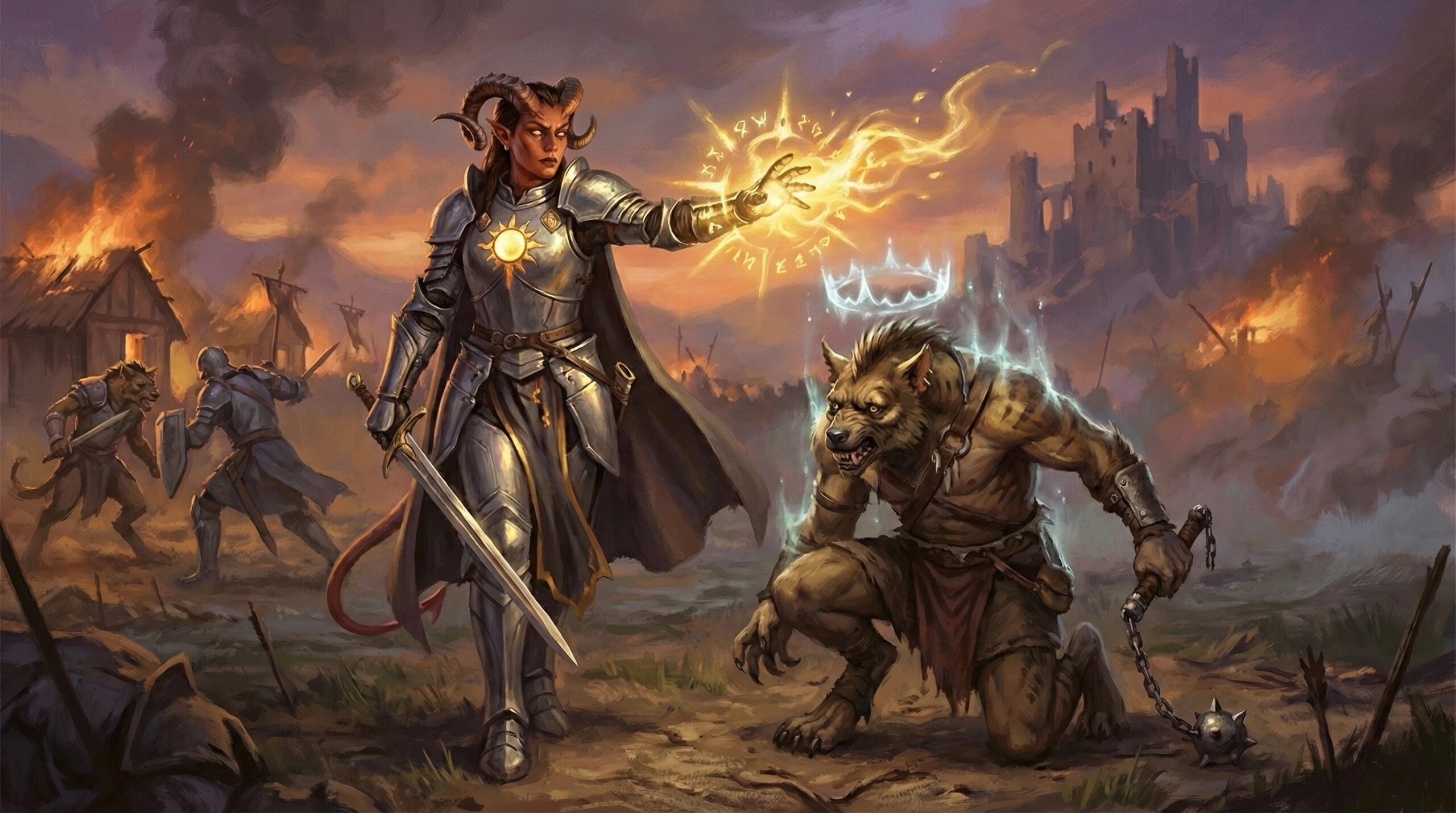
What Does Command Do in 5e?
Command forces a creature to make a Wisdom saving throw. On a failure, you dictate its entire next turn by choosing one of five specific options:
- Approach: The target moves directly to you. This is ideal for pulling ranged enemies into the meat grinder of your party’s melee line.
- Drop: The target drops what it is holding and ends its turn. This is a “hard” disarm that also stuns the enemy for the round.
- Flee: The target runs away. This forces the creature to use its movement, which triggers Opportunity Attacks from your allies.
- Grovel: The target falls Prone and ends its turn. This grants Advantage to all melee attackers who hit it before its next turn.
- Halt: The target does nothing. A simple “skip turn” button.
How did Command change in the 2024 PHB?
The 2024 update fundamentally altered the power profile of Command, turning it from a creative utility tool into a combat sledgehammer. The key changes are:
- Universal targeting (Buff): The 2014 version failed against Undead or creatures that didn’t speak your language. The 2024 version works on anything (except creatures immune to Prone if you choose Grovel). You can now Command a Skeleton, a Beast, or a Construct.
- “Directly Harmful” clause removed (Buff): The snippet text no longer contains the general rule that “the spell has no effect if… your command is directly harmful.” Instead, the safety of the movement is baked into the descriptions of “Approach” and “Flee.”
- Upcasting no longer requires proximity (Buff): The 2014 version read: “The creatures must be within 30 feet of each other when you target them.” The 2024 version does not; you can target one creature 60 feet north of you and another creature 60 feet south of you when you upcast Command.
- Closed command list (Nerf to versatility): You can no longer invent commands like “Betray” or “Autodefenestrate.” You must choose from the five listed options. This removes DM adjudication arguments but limits out-of-combat utility.
Spell Rating: Command
Overall: 👑 A-Tier (Offensive and Defensive Powerhouse)
Contextual Performance (1-10)
-
Combat: 9/10. Command is arguably the best Level 1 non-concentration control spell in the game. It trades 1 Action and a Level 1 slot to delete 100% of an enemy’s turn…and adds to your party’s damage. Against a single boss monster, this trade is mathematically devastating.
The Math: Prevention vs. Cure
Scenario: A CR 5 Hill Giant (2 attacks, 36 potential damage) vs. a Level 5 Party.
- The Threat: Assuming a standard 65% hit rate, the Giant deals ~23 expected damage per round.
- The Reactive Healer (Cure Wounds): You let the Giant attack. You cast Cure Wounds (Level 1) to heal ~13 HP. Result: Your ally is still down -10 HP.
- The Proactive Commander (Command – Halt): You cast Command. Assuming a 65% save failure rate, you prevent the Giant’s turn.
Math: 23 expected damage × 65% chance of success = ~15 damage prevented (on average).
Verdict: Mathematically, a 1st-level Command is more efficient (~15 value) as a 1st-level Cure Wounds (~13 value). That’s before we even get into how much you boost party damage.
The Math: The “Grovel” Damage Boost
Scenario: You cast Command:Grovel. A Level 5 Rogue (Rapier + 3d6 Sneak Attack) and Level 5 Paladin (Longsword x2) attack the prone target.
- Baseline (No Command): At 65% accuracy and 5% crit chance, the duo deals ~24.6 expected damage.
- With Grovel (Advantage): Advantage boosts accuracy to ~88% and nearly doubles crit chance to ~9.75%.
- Rogue: Damage jumps from 13.1 → 18.1 (+38% increase).
- Paladin: Damage jumps from 11.5 → 15.8 (+37% increase).
- Total Value: The duo deals ~34 damage total.
Verdict: Casting Command added ~9.4 “virtual damage” to the round — roughly equivalent to attacking with a Greatsword yourself — while also denying the enemy’s turn. You get the control of a spellcaster and the damage contribution of a martial character in one Action.
Or, let’s say you use Flee or Approach to trigger even just one opporunity attack for your party’s Rogue.
The Math: The “Double Sneak Attack”
Scenario: You cast Command (Flee or Approach) on a target engaged by a Level 5 Rogue. The target fails the save and runs, provoking an Opportunity Attack.
- The Mechanic: Sneak Attack applies once per turn. The Opportunity Attack happens on the enemy’s turn, resetting the Rogue’s limit.
- The Potential Damage: A Level 5 Rogue (Rapier + 3d6 Sneak Attack + 4 Dex) deals ~19 damage on a hit.
- Expected Damage: With a 65% hit rate and 5% crit rate, this reaction adds ~13.1 expected damage.
Verdict: A standard 1st-level damage spell like Guiding Bolt deals ~9.8 expected damage. Command (Flee/Approach) deals nearly the same damage (~8.5 expected value after save variance) purely through one ally’s reaction, plus it wastes the enemy’s turn. You are essentially casting a damage spell and a control spell simultaneously.
-
Exploration: 1/10. The removal of open-ended commands (like “Unlock” or “Open”) has gutted the exploration utility. It is now strictly a combat or chase spell.
-
Social: 3/10. You might be able to use “Halt” or “Drop” to de-escalate a fight with guards or stop a thief, but the nuance of the 2014 version is gone.
Core Metrics (1-10)
-
Raw Power: 8/10. Refer to the above scenarios for why and how Command can match or exceed the damage potential of purely damage-dealing Level 1 spells.
-
Versatility: 4/10. You are locked into five behaviors. However, the removal of the creature type restrictions means the spell is versatile in who it targets, even if what it does is fixed.
-
Efficiency: 7/10. It does not require Concentration. This allows a Cleric to set up Spirit Guardians or Bless on Turn 1, and then control the battlefield with Command on Turn 2, 3, and/or 4. At its best, it can also achieve multiple things in one spell cast (triggering multiple opportunity attacks and wasting the enemy’s turn).
-
Upcast Scaling: 8/10. Targeting additional creatures is the best form of scaling. At 3rd Level, shutting down two enemies is (arguably) better than Hold Person because it works on monsters, not just humanoids.
Check out my comprehensive guides on the:
Playstyle and Synergy
-
Playstyle: The “Turn Skip.” Use this against high-damage Brutes (Ogres, Giants) who usually have poor Wisdom saves. If the enemy relies on a weapon, use Drop. If they rely on Multiattack, use Halt.
-
Party Synergy: Excellent. The Flee command is a best-in-class synergy tool. If you have a Rogue in the party, Commanding an enemy adjacent to them to “Flee” grants the Rogue a Reaction Sneak Attack (since Sneak Attack can trigger once per turn, not per round).
Player Tip: The “Non-Verbal” Loophole
In the 2014 rules, if you met a foreign culture or a pack of Wolves, Command was useless because they didn’t speak Common. In the 2024 rules, the text says: “The spell has no effect if the target is undead, if it doesn’t understand your language…” is gone.
This implies the magical command transcends language barriers. You can now Command a Wolf to “Halt,” an Iron Golem to “Drop,” or a foreign mercenary to “Flee.” Do not underestimate this spell against Beasts and Monstrosities; they often have terrible Wisdom scores and no way to resist you anymore.
What Are the Rules for Command in 5e?
The rules for Command in the 2024 Player’s Handbook are as follows:
-
No matter the Command you choose, the target cannot use actions or bonus actions. It is a complete turn wipe. How you choose to waste that turn (running away, coming closer, falling prone, dropping what they’re holding, or doing nothing at all) is up to you, but the target is not taking an action or bonus action regardless of which option you select.
-
“Flee” and “Approach” can trigger Opportunity Attacks. Forced movement does not trigger Opportunity Attacks if the creature is moved by an external force (like a shove). However, Command forces the creature to use its own movement (“moves… by the fastest available means”). Therefore, it provokes attacks from everyone it runs past.
-
Command cannot (directly) break concentration. None of the effects caused by Command are meant to be powerful enough to immediately incapacitate an enemy. However, if you Command the creature to flee/approach, and the creature takes damage, then that damage might break the creature’s concentration.
-
Command is not a Charm. If a spell causes the Charm effect, it will explicitly say so. Being Charmed is a specific condition. This means things like Fey Ancestry don’t work on Command.
-
The effects of Command don’t occur until the target’s turn in the initiative order. If you issue the command “drop,” for instance, they won’t immediately drop their weapon and shield.
-
Command does not require Concentration. You can cast this while maintaining another powerful spell. It is an “instantaneous” duration that imposes an effect for the next turn.
-
Undead are not immune. Unlike the 2014 version, skeletons, zombies, and vampires are valid targets. Look out Strahd!
How to Use Command in 5e
Here are the optimized ways to utilize Command under the 2024 rules:
-
Steal weapons. Against a boss wielding a powerful magic weapon, use Command: Drop. The boss drops the weapon and ends its turn. On your next ally’s turn, they can run in, use their free Object Interaction to pick up the weapon (or kick it away), and the boss is now permanently nerfed.
-
Trigger opportunity attacks. If your Rogue is in melee with a target, cast Command: Flee. The target runs. The Rogue gets an Opportunity Attack. Since it is not the Rogue’s turn, they can apply Sneak Attack damage again (assuming they meet the criteria), effectively doubling their damage output for the round.
-
Target low Wis monsters. Don’t metagame too hard, but creatures with Wisdom save proficiencies (like Strahd) are unlikely to fail to your Command.
-
Save it for when you can guarantee multiple allies will benefit. This means use Command:Grovel when you’re certain that two melee allies will go after the enemy’s turn. This means paying special attention to the initiative order.
Alternatively, if you’re using Flee or Approach, pay attention to what the “shortest and most direct route” or “fastest available means” are. When that route involves taking multiple opporunity attacks from your allies, that’s when you’ll get the most expected value out of Command.
Is Command 5e a Good Spell?
Yes, Command is a fantastic Level 1 spell in the 2024 version of DnD 5e.
-
Reliability: Most low-level control spells (Sleep, Color Spray) fall off as enemies gain HP. Command targets Wisdom (a stat that stays relatively low on Brute monsters) and denies actions regardless of the enemy’s HP.
-
Safety: Unlike Thunderwave or Burning Hands, Command has no friendly fire and stays relevant in later tiers of play. You can surgically remove one enemy from the combat order without risking your allies.
Command 5e DM Tips
The 2024 update simplifies Command for DMs by removing the “creative interpretation” arguments, but it introduces a new headache: The Disarm.
Players will quickly realize that Command: Drop is a “Save or Lose” for weapon-reliant bosses. If you run a Death Knight or a Fire Giant, one failed save means their weapon is on the floor, and the players will steal it before the boss acts again.
To counter this without being unfair:
- Give bosses backup weapons (a sidearm dagger).
- Give bosses natural attacks (slams, punches, bites) so they aren’t helpless.
- Save Legendary Resistances specifically for this spell.
DnD 5e Command FAQ
-
Does Command work on Undead in 2024? Yes. The 2024 update removed the restriction that made Undead immune. You can now Command Zombies, Skeletons, and Vampires.
-
Do I need to speak the target’s language? No. The 2024 spell description no longer requires the target to understand your language. The magic conveys the intent of the command telepathically or intuitively.
-
Does Command: Flee/Approach provoke attacks of opportunity? Yes. Opportunity attacks occur when a creature uses its Action, Reaction, or Movement to leave a reach. Since Command forces the creature to use its own movement/action to flee/approach, it triggers these attacks.
2014 Command (Legacy Version)
The text below covers the version of Command found in the 2014 Player’s Handbook. I have preserved this section for players running legacy campaigns or using older modules that haven’t updated to the 2024 rule set.
If you are playing with the 2024 rules, use the guide at the top of this page.
You speak a one-word command to a creature you can see within range. The target must succeed on a Wisdom saving throw or follow the command on its next turn. The spell has no effect if the target is undead, if it doesn’t understand your language, or if your command is directly harmful to it.
Some typical commands and their effects follow. You might issue a command other than one described here. If you do so, the GM determines how the target behaves. If the target can’t follow your command, the spell ends.
Approach. The target moves toward you by the shortest and most direct route, ending its turn if it moves within 5 feet of you.
Drop. The target drops whatever it is holding and then ends its turn.
Flee. The target spends its turn moving away from you by the fastest available means.
Grovel. The target falls prone and then ends its turn.
Halt. The target doesn’t move and takes no actions. A flying creature stays aloft, provided that it is able to do so. If it must move to stay aloft, it flies the minimum distance needed to remain in the air.
Casting Time: 1 Action
Range: 60 feet
Components: V
Duration: 1 round
School: 1st-level Enchantment

Matt Zane
Author, DnD Lounge