If the webs aren’t anchored between two solid masses (such as walls or trees) or layered across a floor, wall, or ceiling, the web collapses on itself, and the spell ends at the start of your next turn. Webs layered over a flat surface have a depth of 5 feet.
The first time a creature enters the webs on a turn or starts its turn there, it must succeed on a Dexterity saving throw or have the Restrained condition while in the webs or until it breaks free.
A creature Restrained by the webs can take an action to make a Strength (Athletics) check against your spell save DC. If it succeeds, it is no longer Restrained.
The webs are flammable. Any 5-foot Cube of webs exposed to fire burns away in 1 round, dealing 2d4 Fire damage to any creature that starts its turn in the fire.
Casting Time: Action
Range: 60 feet
Components: V, S, M (a bit of spiderweb)
Duration: Concentration, up to 1 hour
School: Level 2 Conjuration
Who can cast Web? Wizards, Sorcerers, and Artificers have Web on their class spell lists.
| Category | Score |
|---|---|
| Combat Rating | 10/10 |
| Exploration Rating | 2/10 |
| Social Rating | 1/10 |
| Raw Power | 9/10 |
| Versatility | 7/10 |
| Efficiency | 7/10 |
| Upcast Scaling | 1/10 |
Learn more about how my spell rating system works
Web 5e
Web is widely considered the gold standard for low-level battlefield control in DnD 5e. It offers an immense area of effect, a debilitating condition (Restrained), and creates difficult terrain that persists even if enemies pass their saves. It is the spell that teaches Wizards and Sorcerers that doing damage is often the least effective way to win a fight.
In the 2024 update, Web remains largely the same powerhouse it was before, though the rules regarding how creatures escape the webs have shifted slightly, impacting which monsters are most likely to get stuck.
What Does Web Do in 5e?
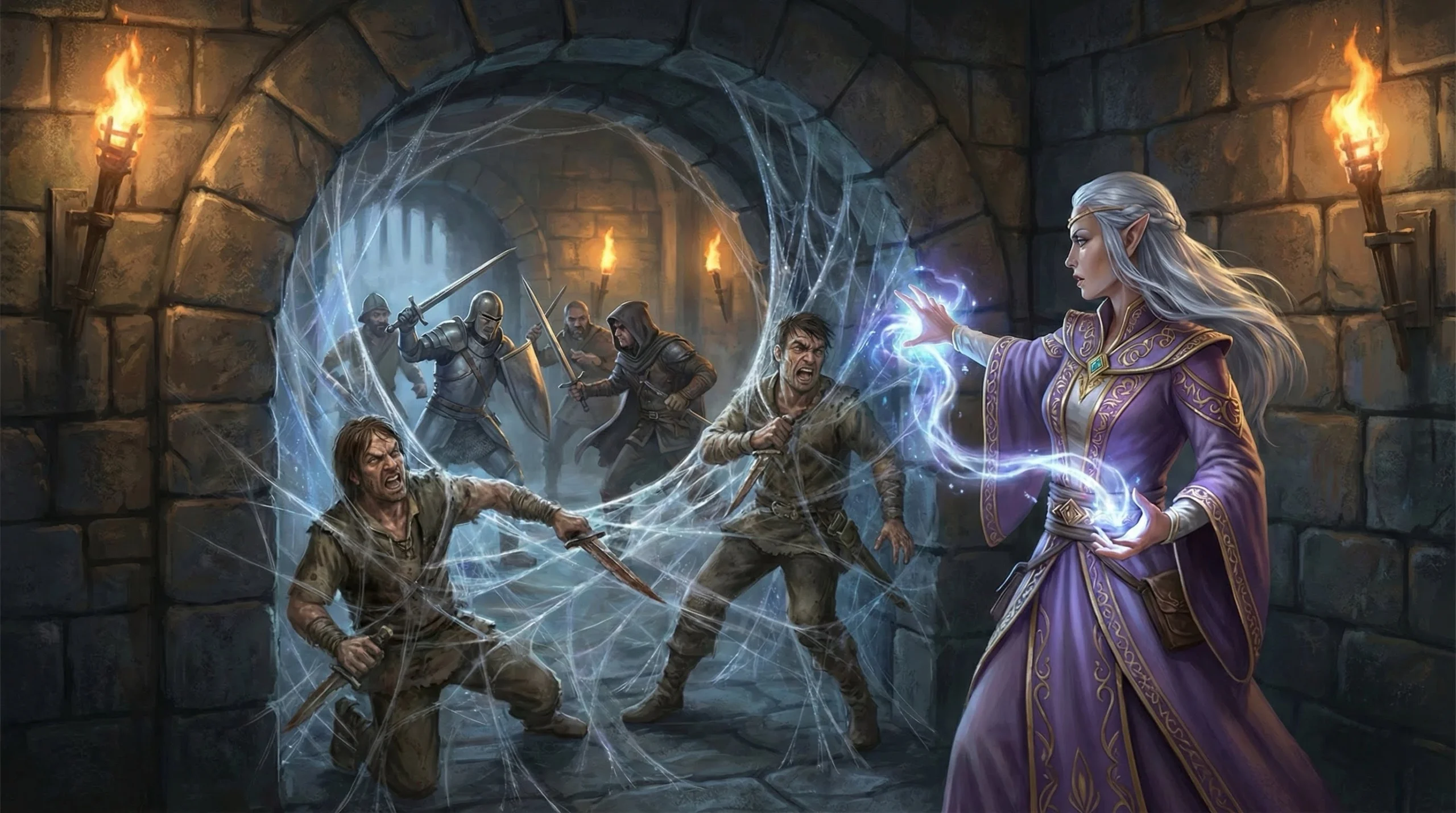
Web creates a 20-foot cube of webs that create difficult terrain and lightly obscure their area. The webs must anchor to two solid masses or be layered across a surface (like a wall, the ceiling, or the ground), or else they collapse, and the spell ends at the start of your next turn.
Any creature that starts its turn in the webs or enters them during its turn must pass a Dexterity saving throw or become retrained. A restrained creature can use an action to make a Strength (Athletics) check against your spell save DC to break free.
If a 5-foot cube of webs is exposed to fire, that part of the webs burns away in 1 round and deals 2d4 (average 5) fire damage to any creature that starts its turn in the fire.
What does the restrained condition do?
While you have the Restrained condition, you experience the following effects.
-
Speed 0. Your Speed is 0 and can’t increase.
-
Attacks Affected. Attack rolls against you have Advantage, and your attack rolls have Disadvantage.
-
Saving Throws Affected. You have Disadvantage on Dexterity saving throws.
How did Web change in the 2024 PHB?
The 2024 version of Web functions almost identically to its 2014 predecessor, with one distinct mechanical shift regarding how creatures escape.
- Escape check change. In the 2014 rules, a creature made a raw Strength check to break free. In 2024, the creature makes a Strength (Athletics) check. This makes it slightly easier to break free of Webs for creatures (or PCs) that are proficient in the Athletics skill.
- Condition clarity. The text now explicitly references the “Restrained condition,” aligning with the clearer keywords of the 2024 edition. This is not a mechanical change; just a change in verbiage.
Spell Rating: Web
Overall: 🕸️ S-Tier (The Controller’s Crown)
Contextual Performance (1-10)
-
Combat: 10/10. Web is the definition of a combat-winning spell. A 20-foot cube is massive (affecting up to 16 squares on a grid if placed on the ground). The Restrained condition grants Advantage to all your allies’ attacks, imposes Disadvantage on the enemy’s attacks, and gives the enemy Disadvantage on Dexterity saving throws. If you catch even 3 out 6 enemies in this, the encounter is going to be much, much easier to win, with fewer resources.
Used in choke point, the difficult terrain alone may buy your party one extra turn of not being hit by a melee enemy, even if they pass their save.
-
Exploration: 2/10. While primarily a combat spell, Web has some exploration utility. You can use it to block a hallway to delay pursuers or create a temporary bridge across a chasm (if anchored properly).
-
Social: 1/10. No real social utility, unless you’re using it to show a neutral spider enemy that you’re cool like them to avoid a fight. 🙂
Core Metrics (1-10)
-
Raw Power: 9/10. While it deals no immediate damage, the mathematical swing provided by the Restrained condition is massive. Granting Advantage to your Paladin and Rogue essentially doubles their crit chance and drastically increases their DPR (Damage Per Round). A near +40% boost in party damage output is nasty, especially when it applies to multiple enemies.
Impact of attack advantage
Metric Normal Attack With Advantage Benefit Hit Chance (Total) 65% 87.75% +22.75% Crit Chance 5% 9.75% +4.75% Expected Damage 6.78 9.31 +2.54 (+37.4%) Assumes 10 average damage where critical hits add 1d10 (5.5) extra damage.
Plus, you’re reducing incoming damage. Melee enemies will have to waste a full turn just to attempt to get free, dealing 0 damage on that turn (or multiple turns, if they keep failing). And ranged enemies and spell attackers will attack with disadvantage.
Impact of attack disadvantage
Metric Normal Attack With Disadvantage Penalty Hit Chance (Total) 65% 42.25% -22.75% Crit Chance 5% 0.25% -4.75% Expected Damage 6.78 4.24 -2.54 (-37.4%) Assumes 10 average damage where critical hits add 1d10 (5.5) extra damage.
-
Versatility: 7/10. Useful indoors (on the ground), outdoors (with trees), defensively (blocking paths), offensively (boosting hit and crit chance), and against flyers (auto-fall if restrained + fall damage). The chasm-connector offers moderate out-of-combat utility in very specific scenarios (a 20-foot chasm that your party can’t otherwise traverse safely).
-
Efficiency: 7/10. For a level 2 spell slot, you can completely neutralize a group of enemies for multiple rounds. Even if they pass the save, they are stuck in difficult terrain. Even if they break free, they wasted an action to do so. It creates a “lose-lose” situation for the DM. That said, Concentration spells always have an opporunity cost.
-
Upcast Scaling: 1/10. There is no benefit to casting this using a higher-level spell slot.
Check out my comprehensive guides on the:
Playstyle and Synergy
-
Playstyle: Control and Area Denial. You cast this to split an enemy encounter in half, trapping some foes while your party focuses on the others.
-
Party Synergy: Excellent. This spell enables almost every other build. Rogues get easy Sneak Attacks; Paladins get crit-fishing opportunities; Casters with Dexterity save spells (like Fireball) get targets who roll with Disadvantage. It pairs perfectly with Warlocks using the Push mastery or Repelling Blast to knock enemies back into the web.
I made this video for the 2014 version of Web; it’s still accurate, but I reference a “Strength” check to break free, rather than the 2024 version’s “Strength (Athletics)” check.
What Are the Rules for Web in 5e?
The rules for Web in DnD 5e are as follows:
-
Multiple saves aren’t required when moving through the Web spell. As the spell reads, a creature only needs to make a saving throw the “first time a creature enters the webs on a turn or starts its turn there.”
In other words, if you start your turn in Web, and then break free of it, you do not need to make any more saving throws to walk through the web (although it’s still difficult terrain, requiring twice as much movement to move through).
Similarly, if you voluntarily walk into Web on your turn and pass your saving throw, you’re good to continue walking through the web without making any more saving throws.
The only time this changes is if you leave the space of the web and then return to it. At that point, you are “enter[ing] them during [your] turn,” which again triggers the saving throw.
Also, if you move through the Web but then end your turn still inside the Web, you will need to make another saving throw at the start of your next turn or become restrained. Again, this is because any creature that “starts its turns in the web” must make a saving throw, regardless of past saves.
-
A creature doesn’t make their saving throw until their turn. Like Moonbeam and Spirit Guardians, nothing happens right away when you cast Web.
-
Web can hit flying creatures, but it disappears on the following round. Web doesn’t need to be anchored or layered on a surface to be cast — it’ll just end earlier if it isn’t. This means you can hit flying creatures with it, restraining them and forcing them to fall (as flyers without hover/Fly spell fall when their speed drops to 0) (PHB 2024, pg. 367).
-
Web’s fire effect does 2d4 fire damage regardless of the creature’s size. This was confirmed when a player asked lead rules designer Jeremy Crawford whether a gargantuan creature would take 54d4 fire damage if they were in a web that was burnt with a Fireball spell.
His answer was no, and that this combination will only ever do 2d4 fire damage, “regardless of the creature’s size.”
-
Web is 5 feet thick when on a flat surface rather than anchored. You can think of them as a stack of square pancakes with air pockets. Basically, you get a vertical, obscurity-creating mess or horizontal bridge-like web if you anchor them, as opposed to a thick mess of webs if you layer them.
-
You don’t have to see the whole area you hope to affect with Web. Only the point of origin (PHB 2024, pg. 361). From there, the Web could extend beyond where you can see.
-
Only 5-foot cubes at a time burn; it doesn’t automatically spread. Nothing in the spell’s description indicates that fire spreads; in fact, the description is very explicit about 5-foot cubes burning at a time.
-
The fire lasts for one full round of combat (until the initiative order when the fire began). When the spell says that the fire burns away in “1 round,” that means 1 round after the fire began burning. At the start of the creature/player’s turn who began the burning, the fire stops, and the webs stop existing in that space.
Until that happens, the webs are still capable of restraining creatures.
-
It is unclear if you need to target the Web with fire to start its burning. The spell description only says that an area “exposed to fire” begins to burn away. Some DMs take this to mean that a targeted fire spell, like Fire Bolt, has to actually target the web, rather than a creature restrained in it, to begin the web from burning. Others might rule differently.
However, area-of-effect fire spells, like Fireball, automatically cause any space where it and Web overlap to begin burning.
-
A creature forced out of Web’s area is freed from being restrained. If a spell like Thunderwave or Thorn Whip forces a creature out of Web’s area, that creature is no longer restrained. That’s because the spell’s description states that a creature is only restrained “as long as it remains in the webs.”
-
Forced movement triggers the save. The text says “The first time a creature enters the webs.” It does not specify “willingly.” If a Warlock uses Repelling Blast to push an enemy into the Web, that enemy must make the save immediately.
-
Burning the web deals damage, but frees the target. Fire deals 2d4 damage and destroys the web in that 5-foot cube. While 5 damage is nice, the Restrained condition is usually worth much more. Only burn the web if you are trying to kill a very low-health enemy or clear a path for your allies.
Web doesn’t collapse on itself until the start of your next turn in this situation. So for the entire round of combat, wherever the web falls still creates difficult terrain, light obscurement, and has the possibility to restrain creatures and be burned with a fire effect. Then, it vanishes at the start of your next turn, as it hasn’t been anchored on two solid masses or layered on a surface.
How to Use Web in 5e
Here are a few ways to use Web in DnD 5e:
-
Pair with movement-forcing abilities. If you want to get a lot of extra mileage out of the Web spell, pairing it with spells like Thorn Whip, Thunderwave, and (Repelling) Eldritch Blast is a great option. Heck, even the Shove action can work in some situations.
The idea is this: Web a baddie or two, and then whenever they emerge from the spell’s perimeter, force them back into the web on your turn. Every time they start their turn in Web, they have to make the saving throw again or become restrained.
-
Consider the initiative order. Web doesn’t restrain a creature until it starts its turn there — it’s not an immediate effect. This means that if an enemy goes right before you in the initiative order, they won’t make their saving throw for basically a full round of combat. And during that time, they’re not restrained, so your allies can’t take advantage of anything.
Alternatively, your ideal Web target is an enemy who comes immediately after you in the initiative order. If they fail their save at the start of their turn, they’ll either have to use their turn trying to break free or be restrained for a full round of combat, during which time your allies can enjoy attack advantage, and the target’s disadvantage on Dexterity saves.
-
Drop flyers from the sky. Flying creatures without hover or the Fly spell begin to fall if their speed is brought to 0. This represents big fall damage potential (1d6 per 10 feet) and removing an enemy’s tactical advantage (flying) for 1 full round of combat (PHB 2024, pg. 367). Bonus: they’ll also be prone when they fall, so they’ll be slow getting up as well.
This is only optimal if bringing them down is very valuable, as you only get one round of Web’s effects this way before it collapses on itself at the start of your next turn.
Also, consider turn order — Web won’t cause the flying creature to start falling until their turn (if they fail their saving throw). That means if all of your allies are going before the flying creature, they won’t get any benefit at all from the Web spell.
The creature will remain aloft for (basically) a full round of combat and make their save on their turn. Then, even if they fail their saving throw, the Web spell will automatically end at the start of your turn.
On the flip side, the ideal flying target for the Web is immediately after you in the initiative order. If that creature fails its saving throw, it falls on its turn and remains restrained until the start of your next turn. That means all of your allies will have a chance to take advantage of the restrained/land-bound flying creature.
-
Don’t burn the webs…usually. The restrained condition is always better than 2d4 (5 average) fire damage. As a rule, you should never burn any portion of the Web spell. Exceptions might include making a small gap for you/your allies to pass through that a larger creature couldn’t follow through or as the last hit on a severely weakened/fire-vulnerable creature.
-
Use it on groups of enemies. The more enemies you can affect with an area-of-effect spell, the better. It literally multiplies the value of your spell slot. Plus, the restrained condition is good for dealing more damage and reducing incoming damage, so there’s never a “wasted” condition on a creature, even if the effect falls off after only one round of combat.
-
Prioritize enemies that don’t have ranged attacks. All restrained creatures have attack disadvantage, including ranged attacks and ranged spell attacks. However, a melee creature caught in webs must use their turn to break free, meaning that they’re definitely dealing 0 damage for a full round of combat.
A restrained ranged attacker, on the other hand, still has a chance of dealing damage to you or your allies. And a saving throw-based enemy won’t suffer any offensive disadvantage from being restrained, making Web a bit less valuable against spellcasters and the like.
-
Use it in choke points. When enemies are in doorways, narrow paths, or other natural choke points, Web’s utility goes way up. If its truly unavoidable, melee enemies will have no choice but to risk getting restrained or run away.
This also means Web is great for preventing pursuers from following you…or at least slowing them down. On a similar note, Web can be used to cut off escape routes and force enemies to stand and fight — or risk a much stickier retreat than they’d intended.
-
Consider your allies’ positioning. Web can just as easily restrain your friends as it can your foes. This means that it’s usually best to cast Web early in a fight, before everyone’s all grouped up in one big brawl.
On a similar note, you don’t want to trap your allies by putting Web in a choke point that they themselves have to pass through.
-
Get the Cloak of Arachnida. This very rare magic item is a lot of fun if you’re building a consistent Web-slinging character. It comes with tons of fun, spidery-themed perks like increased climb speed, poison damage resistance, and a once-a-day free Web spell that affects twice as much area as the regular spell.
Most fun of all, though, it makes it so that you can’t be caught in webs of any sort. This means you can live in your Web if you want to, all the while laughing at the poor stuck fools in there with you.
-
Drop it if it’s causing more harm than good. I mentioned before that it’s important to consider your allies’ positioning before casting Web. But it’s not the end of the world if you mess up and decide that Web is trapping your allies in a bad situation.
Since you can drop concentration at any point, even when it’s not your turn, I recommend voluntarily letting Web end if the situation calls for it (PHB 2024, pg 363 + Sage Advice).
-
Prioritize low-Dexterity, low-Strength enemies. You may not always have this meta-knowledge, but in general, slow- and/or weak-looking enemies make the best targets for the Web spell. If you want to force the issue, you can also ask your party to use something like Bane to debuff their Dexterity save or Hex to debuff their Strength ability check.
-
Set up big combinations. Restrained creatures are attacked with advantage, meaning all your allies will thank you for the added damage. But among the most grateful will be players who rely on advantage or the added chance at critical strikes that advantage affords, like Sneak Attacking Rogues and Divine Smiteing Paladins.
And, of course, there’s always the Web/Fireball combination to take advantage of disadvantage on Dexterity saves from being restrained, as well as the added 2d4 fire damage. As I said earlier, I don’t usually like to burn the Web if it can be helped, but if you’re relatively certain that a failed Fireball save plus the added 5 fire damage will kill all/most of the Web’d enemies, it’s a flashy way to rack up a few killing blows.
-
Slow enemies down. Even enemies who pass their saves/ability checks will still be slowed down by the difficult terrain that Web creates. This isn’t so much a “use” as it is a reminder not to feel bad if Web doesn’t have as many immediate results as you’d like.
-
Take advantage of the lightly obscured area. Web creates a lightly obscured area, which gives creatures disadvantage on Perception checks that rely on sight (PHB 2024, pg. 19).
Admittedly, this an incredible niche use of the spell, but you could use Web to help your party hide in the right circumstances.
-
The “Microwave” Combo. Combine Web with ongoing damage zones. Have a Druid cast Spike Growth or a Cleric cast Spirit Guardians near the web. Enemies are stuck in difficult terrain, restrained, and taking damage every turn.
Who Can I Target With Web 5e?
You can target a point in space up to 60 feet away that you can see with Web. Then, the webs either anchor to two solid masses or become layered across a surface (wall, floor, or ceiling).
If the Web isn’t anchored or layered, it collapses, and the spell ends at the start of your next turn.
Is Web 5e a Good Spell?
Yes, Web is an amazing spell in 5e. It provides a large area of battlefield control that slows and restrains enemies. Even more impactful, it can trap enemies more than once over its duration with clever teamplay and movement-forcing abilities.
Web tips the action ecoonmy balance in your party’s favor — it forces enemies to waste their entire action to attempt to break free. If they fail the check, they have wasted their turn doing absolutely nothing.
Providing both offensive and defensive advantages via the restrained condition is great — having it stick around for a full minute is what makes it stand out as superior to a 1st-level spell like Entangle, which is a one-off save or ability check to avoid/escape for the spell’s whole duration.
On the plus side for Entangle, though, is the fact that a creature remains restrained by it even if it’s forced out of the spell’s initial area. In contrast, Webbed creatures who are blown away like this automatically become unrestrained.
And the fact that Entangle targets make their saving throw immediately, rather than at the start of their turn, meaning initiative order isn’t as important a factor to consider before casting it (although it’s still definitely a consideration).
DnD 5e Web FAQ
-
Does Web affect flying creatures? Yes. If a flying creature is in the area of the web and fails its save, it becomes Restrained. If a flying creature has its speed reduced to 0 (which the Restrained condition does) and it does not have the ability to hover, it falls immediately, taking falling damage and landing prone.
-
Does the fire damage from Web spread? No. The spell states “Any 5-foot Cube of webs exposed to fire burns away.” It does not state that the fire spreads to adjacent cubes.
-
Can you cast Web on the ground without anchors? Yes, but with limitations. The spell says “Webs layered over a flat surface have a depth of 5 feet.” If you cast it on the floor, it does not collapse; it simply becomes a sticky carpet 5 feet deep. It still counts as difficult terrain and triggers the saving throws.
2014 Web (Legacy Version)
The text below covers the version of Web found in the 2014 Player’s Handbook. I have preserved this section for players running legacy campaigns or using older modules that haven’t updated to the 2024 rule set.
If you are playing with the 2024 rules, use the guide at the top of this page.
If the webs aren’t anchored between two solid masses (such as walls or trees) or layered across a floor, wall, or ceiling, the conjured web collapses on itself, and the spell ends at the start of your next turn. Webs layered over a flat surface have a depth of 5 feet.
Each creature that starts its turn in the webs or that enters them during its turn must make a Dexterity saving throw. On a failed save, the creature is restrained as long as it remains in the webs or until it breaks free.
A creature restrained by the webs can use its action to make a Strength check against your spell save DC. If it succeeds, it is no longer restrained.
The webs are flammable. Any 5-foot cube of webs exposed to fire burns away in 1 round, dealing 2d4 fire damage to any creature that starts its turn in the fire.
Casting Time: 1 action
Range: 60 feet
Components: V, S, M (a bit of spiderweb)
Duration: Concentration, up to 1 hour
School: 2nd-level conjuration

Matt Zane
Author, DnD Lounge