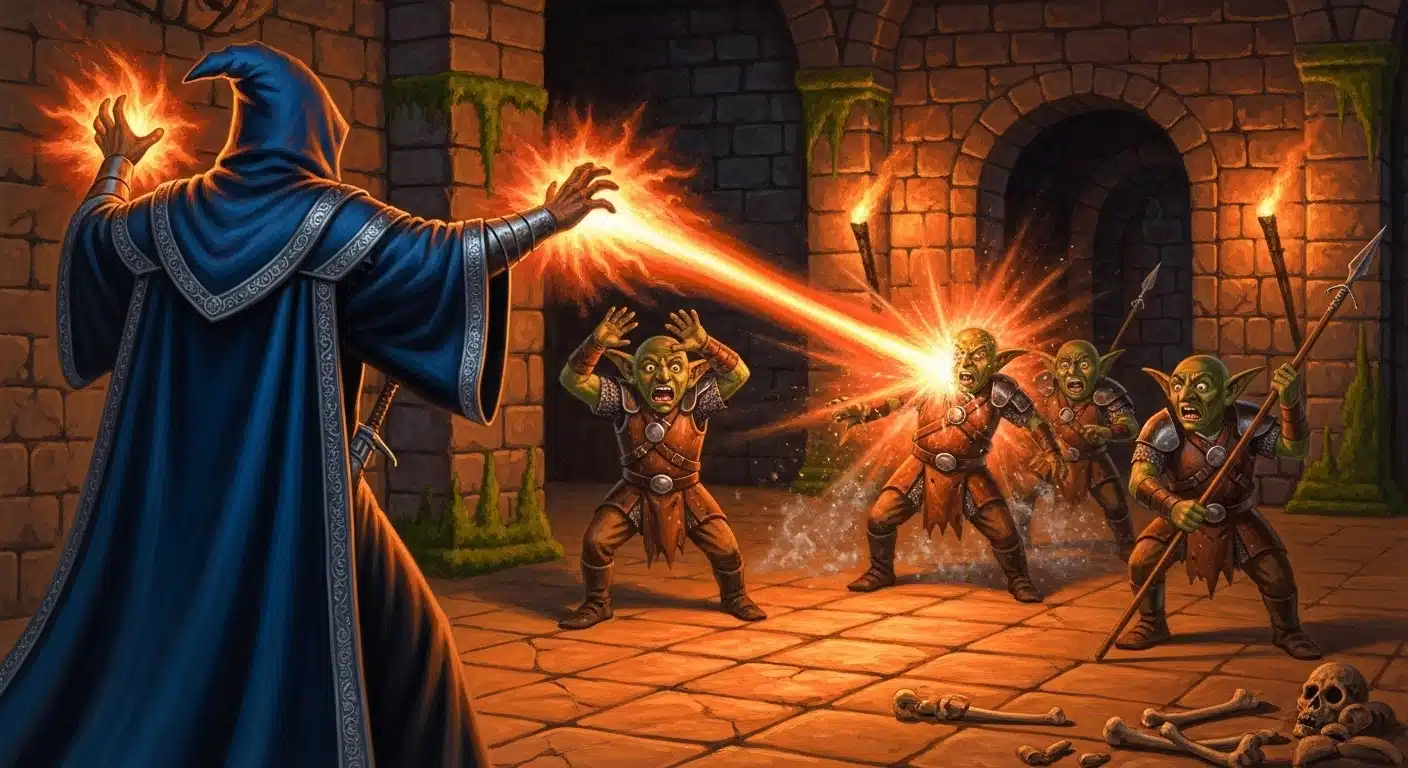
You hurl three fiery rays. You can hurl them at one target within range or at several. Make a ranged spell attack for each ray. On a hit, the target takes 2d6 Fire damage.
Using a Higher-Level Spell Slot. You create one additional ray for each spell slot level above 2.
Casting Time: Action
Range: 120 feet
Components: V, S
Duration: Instantaneous
School: Level 2 Evocation
Player’s Handbook 2024, pg. 313
Who can cast Scorching Ray? Sorcerers and Wizards have Scorching Ray on their class spell lists. Light Clerics get it as a Domain spell. Fiend Warlocks and Efreeti Genie Warlocks have Scorching Ray on their expanded spell lists. Artillerist Artificers and Wildfire Druids (from Tasha’s) also get it prepared.
| Category | Score |
|---|---|
| Combat Rating | 7/10 |
| Exploration Rating | 1/10 |
| Social Rating | 1/10 |
| Raw Power | 6/10 |
| Versatility | 3/10 |
| Efficiency | 7/10 |
| Upcast Scaling | 5/10 |
Learn more about how my spell rating system works
Scorching Ray 5e
Scorching Ray is a straightforward damage-dealing spell that offers the opportunity to spread damage across multiple targets. Let’s get straight into the spell’s basics and how to use Scorching Ray in DnD 5e, then turn to the more contentious rules that often come up at DnD tables.
How Does Scorching Ray Work in 5e?
Scorching Ray allows the caster to make three separate ranged spell attacks against one, two, or three targets within 120 feet. If a ray hits, it deals 2d6 (7 average) fire damage. That works out to (potentially) 6d6 (21 average) total damage.
Upcasting Scorching Ray allows for +1 ranged spell attack per slot level.
Spell Rating: Scorching Ray
Overall: 🔥 B-Tier (Solid Damage Option)
Contextual Performance (1-10)
- Combat: 7/10. A strong offensive spell that can deal up to 6d6 (21 average) fire damage at 2nd level. The three separate attack rolls give you flexibility to focus-fire a single target or spread damage across multiple enemies. It’s especially deadly against low-AC enemies and great for breaking concentration on enemy spellcasters (three chances to force saves). However, you’re gambling on those attack rolls — miss one or two rays and your damage plummets fast. Fire resistance is also common enough to be a concern.
- Exploration: 1/10. Extremely limited. It doesn’t even ignite things, so you can’t use it to burn a rope, light a torch from 120 feet away, or trigger a trap. Even if your DM allowed for it, why would you waste a 2nd-level slot on that? Plenty of cantrips do the same job without burning resources. It offers nothing for navigation, information gathering, or environmental manipulation.
- Social: 1/10. You can’t negotiate with fire. Unless you’re threatening someone (which is more intimidation than “social interaction”), Scorching Ray has zero application in dialogue or roleplay scenarios.
Core Metrics (1-10)
- Raw Power: 6/10. At baseline (2nd-level slot), this spell deals an average of 21 damage if all three rays hit — solid for a 2nd-level spell. The multi-attack nature means you’re more likely to land some damage even if you don’t get all three hits, which normalizes the output. The downside? Each ray is an independent attack roll, so missing hurts. Against high AC targets, your actual damage drops significantly. It’s reliable against weak enemies, but struggles against tanky ones.
- Versatility: 3/10. It does one thing: deal fire damage. You can choose to hit one target or spread it across multiple enemies, which is nice tactical flexibility, but that’s about it. No crowd control, no debuffs, no utility outside of combat. It’s a hammer, not a Swiss Army knife.
- Efficiency: 7/10. As a 2nd-level spell slot and an Action, it’s decent value — if you land your attacks. The efficiency tanks if you’re rolling poorly or facing high AC enemies. Fire damage is resisted more often than radiant or force, which is a knock against it. You’re basically spending an Action and a 2nd-level slot to maybe deal good damage (but you’re pretty likely to deal some damage, which is nice).
-
Upcast Scaling: 5/10. Every slot level above 2nd adds another ray, which means +2d6 (7 average) damage per upcast level. However, Sorcerers and Wizards both get Fireball as a Level 3 spell, and it deals 8d6 damage, beating out a Level 3 Scorching Ray by +2d6 damage. Plus, Fireball deals half damage even if an enemy passes their Dex save.
That said, Scorching Ray is still better than Fireball against enemies who are spread out, and upcasting may be worth it if there are a lot of (low HP) enemies spread out.
Playstyle and Synergy
- Playstyle: Built for Blaster casters who want to deal consistent, focused damage. If you’re playing a Sorcerer or Wizard who wants to delete priority targets fast, this is your spell. It’s aggressive, direct, and rewards good positioning (you want to hit those attacks).
- Party Synergy: Low. It’s good for finishing off wounded enemies that your allies have softened up. However, it doesn’t set up combos for your party or provide any battlefield control. It’s a selfish damage spell, which is fine, but don’t expect it to enable your allies.
Scorching Ray Player Tip
Most of the time, you should focus fire on priority targets, not spread damage. The math might tempt you to spread your rays across three enemies, but the action economy says otherwise. Killing one enemy now is almost always better than wounding three enemies. A dead enemy deals zero damage. Three wounded enemies? Still making three attacks against your party.
Spread damage only when you’re cleaning up low-HP stragglers or need to break concentration on multiple targets.
How to Use Scorching Ray in 5e
Scorching Ray is a simple spell, but there are a few ways to get the most mileage out of it:
-
Prioritize targets you have advantage against. An interesting thing about Scorching Ray’s multi-attack nature is that it scales better with advantage. Not only because you’ll be landing more attacks, but because you’ll also have a higher chance for each of those attacks to deal critical damage.
Focusing all your rays on a single target is often optimal even without advantage, since killing a single enemy faster tips the action economy in your favor.
-
Spread the damage (against low-HP targets). From a tactical standpoint, there are two reasons to choose Scorching Ray over a higher-damage single-target spell — you want to normalize your damage (since more rolls = less random results), and/or you want to hit multiple enemies.
This is especially good for clearing low-health minions quickly — especially those that are spread apart and, therefore, not vulnerable to regular area of effect spells.
-
Break concentration. While Magic Missile is the undeniable king of this function, Scorching Ray is also solid for breaking a spellcaster’s concentration. Each time they’re hit with the spell’s damage, they’ll have to make a DC 10 Constitution saving throw.
-
Pair with Hex. Hex damage triggers every time you deal damage with Scorching Ray. That brings your damage up to 3d6 (10.5 average) per ray that lands — a 50% damage increase.
While only The Fiend Warlocks have access to Scorching Ray, it does make for a strong combo. Additionally, you can always multiclass dip or get the Magic Initiate feat to overcome this obstacle.
-
Pair with Hexblade’s Curse. This is a multiclass-specific option, since Hexblade Warlocks don’t have access to Scorching Ray. But if you do combine Hexblade’s Curse with Scorching Ray, the effects are fantastic.
You’ll get to add your proficiency bonus to damage rolls (which, yes, can happen multiple times per spell cast) and critical strikes happen on a 19 or 20 (Scorching Ray’s multi-attack nature gives more chances for this to happen).
-
Get the Elemental Adept feat. One (small) downside to Scorching Ray is that fire damage is the most commonly-resisted damage type for creatures — Elemental Adept lets you ignore this resistance.
Much more importantly, however, is the second part of Elemental Adept, which allows you to treat any damage roll of 1 as a 2 instead. Since Scorching Ray uses the second smallest die in the game for damage (d6), you’ll see an average of a +1.5 to +2.5 damage boost on 33% of your Scorching Ray attacks that land.
Note that Elemental Adept isn’t a great feat overall, but it’s marginally better if your character is focused on using Scorching Ray and other such multi-attack/area of effect spells.
What Are the Rules for Scorching Ray in 5e?
The rules for Scorching Ray in DnD 5e are as follows:
-
Scorching Ray’s attack rolls are sequential, not simultaneous. While the “instantaneous” casting time of Scorching Ray might suggest that all three attacks happen at the same time, this is not the case. As the Sage Advice Compendium puts it, “you choose the targets and resolve the attacks consecutively, not all at once” (SAC).
-
Scorching Ray triggers “on-hit” effects each time it hits. For spell effects like Hex, which deal bonus damage each time the target is hit by an attack, you can add this bonus damage to each and every Scorching Ray attack that lands (Sage Advice). That’s because each ray of Scorching Ray is a separate attack roll and a separate instance of damage.
As Hex, in particular, points out, you deal extra damage “whenever you hit [the target] with an attack.” Scorching Ray is three (or more) attacks.
@FilipVukelic Hex triggers each time you hit the hexed target, so eldritch blast can trigger it on each hit.
— Jeremy Crawford (@JeremyECrawford) September 17, 2014
-
If you are hidden, only your first attack will have advantage. A bad side of the multi-attack nature of Scorching Ray is that you give away your position after the first attack. So if you’re an unseen attacker benefitting from an advantage, you’ll only get that advantage for the first ray, not follow-ups.
Relevant rules from the Player’s Handbook: “If you are hidden…when you make an attack, you give away your location when the attack hits or misses” (PHB 195).
And for class and subclass feature-specific rules:
-
Draconic Bloodline Sorcerers’ Elemental Affinity only adds damage to one ray of Scorching Ray. As the Sage Advice Compendium puts it, “Elemental Affinity benefits one damage roll per casting of a spell, even if the spell allows more than one roll” (SAC).
-
Evocation Wizards’ Empowered Evocation only adds damage to one ray of Scorching Ray. The feature reads: “…add you Intelligence modifier to one damage roll of any wizard evocation spell you cast” (PHB 117, emphasis added).
-
Sorcerer’s Empowered Spell feature allows you to reroll any Scorching Ray damage dice rolls you want to reroll. For example, if your Charisma modifier is +3, then you can reroll up to 3 damage dice rolls for Scorching Ray per turn.
How did Scorching Ray change in the 2024 PHB?
Scorching Ray did not change in the 2024 Player’s Handbook. It functions identically to its 2014 counterpart, creating three rays that each require a separate ranged spell attack and deal 2d6 fire damage on a hit. The wording changed slightly, but that’s it.
Who Can I Target With Scorching Ray 5e?
Cast as a second-level spell, you can target up to three creatures within 120 feet that you can see with Scorching Ray. For each level you upcast Scorching Ray, you can target one additional creature, for a maximum of 10 targets if used as a 9th-level spell.
Is Scorching Ray 5e a Good Spell?
Yes, Scorching Ray is a good spell. It deals between 0d6 (0) and 6d6 (21 average) damage as a baseline. If we assume about a 2/3 chance of each attack landing, Scorching Ray will typically deal 14 damage as a 2nd-level spell.
Even without the multi-attack nature of the spell and the benefits that provides, this is solid damage, on par with other 2nd-level damage-dealing options like Heat Metal and Shatter.
Scorching Ray 5e Compared to Magic Missile
Scorching Ray often gets compared to Magic Missile, a 1st-level spell that deals an average of 10.5 force damage — without any attack rolls. Cast as a second-level spell, Magic Missile ties Scorching Ray’s (admittedly estimated) average damage of 14 per cast.
For Evocation Wizards, Magic Missile is the better choice. The fact that it automatically lands and deals damage based on just one damage roll makes it exceptional. It benefits more from Empowered Evocation and similar effects that add damage to one damage roll per turn, whereas Scorching Ray will only get limited benefits from these effects.
Magic Missile is also far superior for breaking an enemy spellcaster’s concentration.
For Sorcerers, the choice is less clear-cut. Elemental Affinity can’t affect force damage the way it does for fire damage if you’re a Draconic Bloodline Sorcerer. That makes Scorching Ray a much more attractive option, even if you are only adding damage to one of the spell’s attacks.
For Wizards and Sorcerers of neither of the aforementioned subclasses, it’s more of a choice of consistency and style. Magic Missile will always land, but it has a much lower damage cap than Scorching Ray.
Scorching Ray has a chance to deal much more damage, especially when upcast (+7 per level vs. Magic Missile’s +3.5), but it also has a chance to completely flop.
For my money, I prefer Magic Missile over Scorching Ray for its consistency, both in damage/multi-hitting, but also the fact that there aren’t as many force-resistant/immune creatures as fire.
But overall, you really can’t go wrong — they’re both solid damage-dealing options. I just don’t recommend picking up both spells, as they’ll feel rather redundant in your spellbook.
Scorching Ray 5e DM Tips
I recommend that DMs break one rule we covered in the rules section above: Instead of saying that player gives away their location after the first attack of Scorching Ray, allow them to have advantage on all their Scorching Ray attacks for that round.
It takes away from the unnecessary whining that spells like Magic Missile get a shadow buff for situations like these, where the damage is simultaneous rather than consecutive.
Encourage players to make character-driven choices whenever possible, rather than meta-driven choices. Balancing rough and unnecessary edges from, well, edge cases like this goes a long way in improving QoL and does nothing to hurt the spirit of the game’s mechanics.
DnD 5e Scorching Ray FAQ
Scorching Ray DnD 5e FAQ:
-
Can you use Twinned Spell metamagic on Scorching Ray? No, Twinned Spell metamagic cannot be used on Scorching Ray, as it can target more than one creature.
-
Does Scorching Ray ignite things? No, Scorching Ray does not ignite objects or creatures. It deals fire damage but lacks the specific ability to ignite or set things on fire, like Fire Bolt or Fireball.
2014 Scorching Ray 5e
You create three rays of fire and hurl them at targets within range. You can hurl them at one target or several.
Make a ranged spell attack for each ray. On a hit, the target takes 2d6 fire damage.
At Higher Levels. When you cast this spell using a spell slot of 3rd level or higher, you create one additional ray for each slot level above 2nd.
Casting Time: 1 action
Range: 120 feet
Components: V, S
Duration: Instantaneous
School: 2nd-level evocation

Matt Zane
Author, DnD Lounge