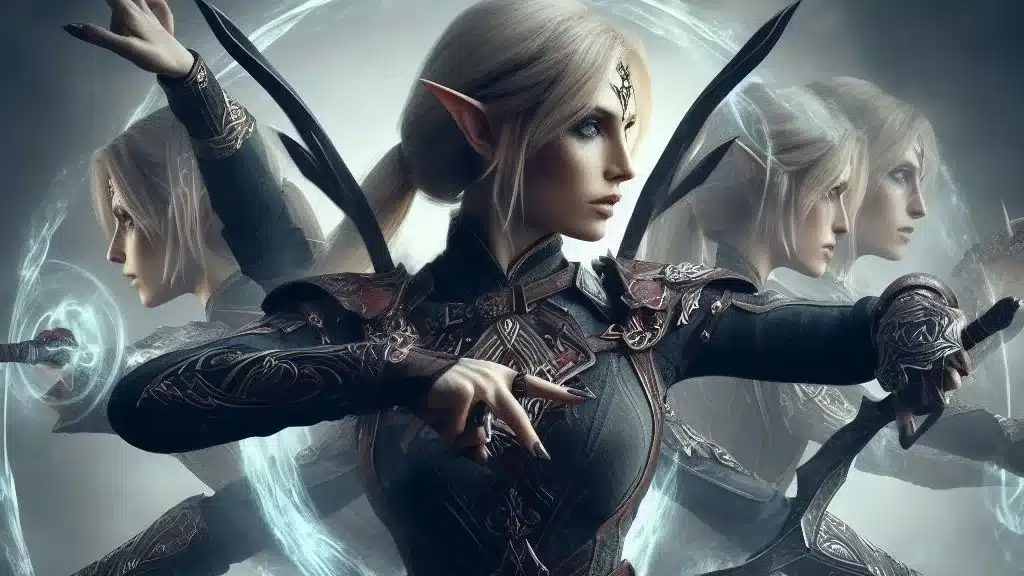
Three illusory duplicates of yourself appear in your space. Until the spell ends, the duplicates move with you and mimic your actions, shifting position so it’s impossible to track which image is real. Each time a creature hits you with an attack roll during the spell’s duration, roll a d6 for each of your remaining duplicates. If any of the d6s rolls a 3 or higher, one of the duplicates is hit instead of you, and the duplicate is destroyed. The duplicates otherwise ignore all other damage and effects. The spell ends when all three duplicates are destroyed.
A creature is unaffected by this spell if it has the Blinded condition, Blindsight, or Truesight.
Casting Time: Action
Range: Self
Components: V, S
Duration: 1 minute
School: Level 2 Illusion
Player’s Handbook 2024, pg. 299
Who can cast Mirror Image? Bards, Sorcerers, Warlocks, and Wizards have Mirror Image on their class spell lists. Trickery Domain Clerics, Land: Coast Druids, and Armorer Artificers get Mirror Image for free and always have it prepared.
Spell Rating
| Category | Score |
|---|---|
| Combat Rating | 9/10 |
| Exploration Rating | 1/10 |
| Social Rating | 2/10 |
| Raw Power | 9/10 |
| Versatility | 1/10 |
| Efficiency | 10/10 |
| Upcast Scaling | 1/10 |
Mirror Image 5e
Mirror Image has been around since the first edition of Dungeons and Dragons, but that doesn’t mean it’s any more straightforward for people playing and DMing DnD 5e. Let’s dive into what makes Mirror Image a great tool in the caster’s toolkit, as well as some of its thornier rules.
How Does Mirror Image Work in 5e?
Mirror Image instantly creates three exact illusory duplicates of the caster. They occupy the same space, look the same, and make the same actions. Whenever a creature lands an attack on the caster, the caster rolls Xd6 (where X = the number of your remaining duplicates). If any of the d6 rolls are 3 or higher, the attack hits a duplicate instead of you, and that duplicate is destroyed.
The duplicates ignore other damage (like from area of effect abilities/spells). They cannot help you if you’re forced to make a saving throw; they only intercede when you are hit by an attack (i.e., the attacker made an attack roll and it beat your AC).
If the attacker has Blindsight, Truesight, or the Blinded condition, it is unnaffected by this spell — its attacks hit you as normal.
The spell ends after 1 minute (with no concentration requirement) or after all 3 duplicates have been destroyed.
Here’s some basic math on the defensive advantages Mirror Image provides as it degrades:
- 3 Duplicates: You roll 3d6. You only fail if you roll a 1 or 2 on all three dice $1 – (2/6)^3 = ~96.3% chance to redirect.
- 2 Duplicates: You roll 2d6. (2/6)^2 = ~88.9% chance to redirect.
- 1 Duplicate: You roll 1d6. 1 – (2/6) = 66.7% chance to redirect.
How did Mirror Image change in the 2024 PHB?
Mirror Image was completely redesigned in the 2024 Player’s Handbook. The 2014 mechanic of rolling a d20 to see if an attack hits a duplicate (based on a DC like 6+, 8+, or 11+) is gone. The duplicates no longer have an AC at all, either.
Instead, when you are hit, you now roll a d6 for each duplicate you have. If any of those d6s rolls a 3 or higher, the attack hits a duplicate instead of you. This is a completely new resolution mechanic.
Also, the old version of the spell had you roll dice before the attack roll; now, you only roll dice after the attack actually lands. That makes using the the new version much more streamlined. The effects that negate it (Truesight, Blindsight, Blinded conidtion) are also now explicitly stated in the spell description.
Beyond being a buff, this redesign is a good example of WotC making a spell much simpler to track at the table. There’s just one die type to remember (d6), one target number to remember (3+), and the number of dice matches your duplicates — so you can simply set down three d6s and remove each one as its duplicate is destroyed.
While I usually focus on the math and how the numbers balance out, it’s also worth appreciating how much cleaner many 2024 mechanics are to actually use during play, especially for newer players.
Mirror Image 2024 vs. 2014: The Math Breakdown
The Verdict: The 2024 version is significantly more powerful and, more importantly, more reliable at higher levels of play.
While the 2014 version had a niche use case where it could theoretically last longer against weak enemies, the 2024 version is a near-guaranteed damage negation shield that scales perfectly from Level 3 to Level 20. Here is the math behind why.
1. The Probability Math (Getting Hit)
The biggest change is the success rate of diverting an attack. The 2024 version uses a “pool” of dice rather than a single threshold roll, drastically increasing your odds of safety.
- 3 Duplicates Remaining:
- 2014 (Roll 6+ on d20): 75% chance to redirect.
- 2024 (Roll 3+ on 3d6): 96.3% chance to redirect.
- 2 Duplicates Remaining:
- 2014 (Roll 8+ on d20): 65% chance to redirect.
- 2024 (Roll 3+ on 2d6): 88.9% chance to redirect.
- 1 Duplicate Remaining:
- 2014 (Roll 11+ on d20): 50% chance to redirect.
- 2024 (Roll 3+ on 1d6): 66.7% chance to redirect.
Math Conclusion: The 2024 version is statistically much safer. With 3 duplicates up, you are almost mathematically guaranteed (96%) to block the next hit, whereas the old version left you with a 1-in-4 chance (25%) of taking damage immediately.
2. The “AC” Problem (Why 2014 Failed at High Levels)
This is the specific mechanic that made the 2024 version superior for high-level play.
The 2014 Flaw (Duplicate AC): In the old version, if an attack was diverted to a duplicate, the attack roll was compared to the Duplicate’s AC (10 + Dex). If you were fighting a Dragon with a +14 to hit, it would auto-hit your duplicate’s AC 12, destroying it instantly.
The 2024 Fix (No AC): The new version removes the Duplicate’s AC entirely. It does not matter if the enemy has a +19 to hit or rolled a Critical Hit. If your d6 rolls a 3 or higher, the damage is completely erased.
Power Shift: The 2024 version scales infinitely. It is just as effective against a Goblin as it is against a Tiamat.
3. The “Trigger” Change (Target vs. Hit)
The 2024 version changed when the spell activates, which is a massive buff to High-AC characters (like Bladesingers or Eldritch Knights).
- 2014 (Trigger: “Targets You”): The spell activated before you knew if the attack would hit your real AC. You could lose a duplicate to an attack that rolled an 11 and would have missed you anyway.
- 2024 (Trigger: “Hits You”): The spell only activates after the DM confirms the attack beats your AC. This acts as “Bad Luck Insurance”—it creates a buffer that only spends resources when you actually need them.
Summary: Which is Better?
| Feature | 2014 Version | 2024 Version | Winner |
|---|---|---|---|
| Block Chance (3 Dupes) | 75% | 96.3% | 2024 |
| Block Chance (1 Dupe) | 50% | 66.7% | 2024 |
| High Level Viability | Poor (Enemies auto-hit duplicates) | Excellent (Ignores enemy To-Hit) | 2024 |
| Resource Economy | Wastes duplicates on misses | Only uses duplicates on Hits | 2024 |
Final Conclusion: Unless you are fighting zombies with terrible aim, 2024 Mirror Image is a massive upgrade.
 Loading ...
Spell Rating: Mirror Image
Overall: 🛡️ S-Tier (Essential Defense)
Contextual Performance (1-10)
- Combat: 9/10. This is arguably the best defensive spell in the game for the 2024 edition. Unlike Shield (which fails against high attack rolls) or Blur (which requires Concentration), Mirror Image offers guaranteed damage negation. Because the 2024 version removes the “Duplicate AC” rule, this spell effectively grants you three “Hit Immunities” regardless of the enemy’s power level. Whether you are fighting a goblin or an Ancient Dragon, a duplicate blocks the hit all the same. The only reason it isn’t 10/10 is that it costs an Action to set up; if you can cast it before combat begins, it’s an easy 10/10.
- Exploration: 1/10. Extremely situational. Perhaps you could use it to trigger a visual-based trap by walking a duplicate into it? In reality, the duplicates move with you in your space, so that would require a very generous DM.
- Social: 2/10. You might get some mileage out of this for Intimidation checks (“I am legion!”), or to confuse a simple-minded guard. However, standard illusions like Silent Image or Minor Illusion are generally better for trickery. This is a war spell, not a talk spell.
Core Metrics (1-10)
- Raw Power: 9/10. In the 2024 rules, this spell functions as “Bad Luck Insurance.” With three duplicates, you have a 96.3% chance to ignore the next attack that hits you. That is mathematically absurd. It negates Critical Hits entirely (the duplicate takes the crit and vanishes). For a squishy Wizard or Sorcerer, this survivability is unmatched by any other 2nd-level spell.
- Versatility: 1/10. It does exactly one thing: it keeps you alive when things try to stab you. It provides no utility, no movement, and no damage. It is a specialist tool, but it is the master of its trade.
- Efficiency: 10/10. This receives a perfect score for one reason: No Concentration. In DnD, Concentration is your most valuable currency. Mirror Image allows you to maintain a game-winning spell like Hypnotic Pattern, Fly, or Spirit Guardians while still having a top-tier defensive layer active. It does not compete with your offense; it enables it.
- Upcast Scaling: 1/10. There is no benefit to upcasting this spell. Casting it with a 9th-level slot does the exact same thing as a 2nd-level slot. This is actually a good thing — it remains cheap to cast even at Level 20 — but don’t expect it to get stronger with more resources.
Playstyle and Synergy
- Playstyle: Mandatory for “Squishy” casters (Wizards, Sorcerers) who fear getting one-shot by high-damage enemies. It is also top-tier for “Gish” builds (Bladesingers, Eldritch Knights, Warlocks) who are constantly in melee. Because it triggers after a hit is confirmed, high-AC characters get the most value out of it, as they only lose duplicates on the rare occasions an enemy rolls high enough to touch them.
- Party Synergy: Medium. While it is a “Self” spell, it protects the party indirectly by protecting your Concentration. If you are Hasting the Barbarian or holding a Hold Person on the boss, keeping yourself safe keeps the party buffed.
Mirror Image Player Tip
Trust the new math — it creates legendary moments.
I recently ran a session (Tier 3 play) where our Wizard was cornered by a Marilith. If you know Mariliths, you know they make seven attacks per turn. In the 2014 rules, her high “To Hit” bonus (+9) would have popped every single duplicate instantly because she would have automatically hit their low AC.
But with the 2024 rules? The Marilith rolled a Critical Hit on her first swing. The table went silent. The Wizard rolled his 3d6 for Mirror Image and got a 5. Result: The Critical Hit annihilated a duplicate, and the Wizard took zero damage. He proceeded to block 3 out of the 4 hits that landed that turn. Under the old rules, he would have been unconscious. Under the 2024 rules, he just dusted off his robes and cast Disintegrate. Prepare this spell.
How to Use Mirror Image in 5e
Mirror Image is a defensive spell, so you’ll want to save it for times when you think you’re likely to be hit or want to stay extra safe. Here are some popular applications of the spell:
- Staying alive. Mirror Image reduces your chance to be hit by an attack by 30-55% for 1 minute without a concentration requirement. That’s a pretty serious defensive advantage that’ll help keep monsters from getting through your squishy caster body.
- Protecting concentration on higher tier spells. Mirror Image retains its utility well late into the late game without the need for any upcast potential or eating up your concentration. That reduction to your chance to be hit serves as a bonus layer to keep concentration maintained on a higher tier, more impactful spell.
- Getting ahead in actions when you’re outnumbered. Mirror Image is great for managing the action economy. If you’re split up from your party and need to deal with a horde of low-level baddies, Mirror Image ensures that only a handful of attacks get through.
- Pair with the Sentinel feat. Sentinel’s final line about getting a free attack when a creature in melee range targets someone other than you pairs incredibly well with Mirror Image. It makes it not only a defensive boon, but also a terrifying offensive spell.
- Use Darkness to beat it. If you’re up against a Mirror Image-casting caster (or any baddie caster that relies on sight-based illusions), the Darkness spell can help even out the odds. Because when no one can see in DnD 5e, it’s like everyone can.
- Performances. Some folks like to use Mirror Image to make for an immediate team of backup dancers when putting on a show — if you’re willing to drop a second-level spell slot for a performance advantage, your DM better let you get away with it.
What Are the Rules for Mirror Image in 5e?
The rules for Mirror Image in DnD 5e are as follows:
-
- Saving throw-based damaging effects won’t ever hit your duplicates. Mirror Image is very explicit that it only works when “a creature hits you with an attack” (emphasis added). The attack action is a very specific thing in DnD 5e (PHB 193-4).
Ranged spell attacks are definitely attacks, but spells that rely on saving throws, like Fireball and Toll the Dead, will be unaffected by Mirror Image — the caster is the only one who makes a saving throw if targeted by a spell that forces one, and the spell behaves normally.
- Same goes for any spell that deals damage without an attack. Spells like Magic Missile, which simply “work” and deal damage without any attack roll or saving throw, are also unaffected by Mirror Image.
- Saving throw-based damaging effects won’t ever hit your duplicates. Mirror Image is very explicit that it only works when “a creature hits you with an attack” (emphasis added). The attack action is a very specific thing in DnD 5e (PHB 193-4).
The mirror image spell has no effect on magic missile, which doesn’t involve an attack. #DnD https://t.co/oJlHlRYShQ
— Jeremy Crawford (@JeremyECrawford) March 15, 2016
-
- You can provoke an attack from the Sentinel feat if your duplicate is hit. The Sentinel feat allows you to use your reaction to attack a creature within 5 feet when they attack a target other than you. If someone within 5 feet of you attacks you and ends up hitting a duplicate, you can use your reaction to attack them. Here’s Sage Advice confirmation.
Yes.
— Jeremy Crawford (@JeremyECrawford) October 3, 2018
-
- If you become invisible, so do your mirror images. Your duplicates imitate your appearance at all times, so anything you do, they do. Here’s Sage Advice confirmation.
Mirror image creates illusory duplicates of you that imitate your appearance. If your appearance goes away—you become invisible, for example—then the duplicates imitate that too. #DnD https://t.co/tIsbimuR4J
— Jeremy Crawford (@JeremyECrawford) May 24, 2018
- Darkness trumps Mirror Image. One underrated application of the Darkness spell (or anything else that effectively blinds both you and your adversary) is that it evens the playing field with visual illusions like Mirror Image.
When no one can see, it’s like everyone can see (the way advantage and disadvantage cancel out — it’s confusing, read my article on Darkness).
- Other melee attacks. We mentioned a few things that aren’t considered attacks, but I should also clarify some things that are</i considered attacks:
- Opportunity attacks
- Attempting to grapple
- Shoving
All of these are subject to Mirror Image’s effects, as they’re all attacks directed at the caster.
- The duplicates always occupy the caster’s space. Functionally, you don’t need to set up 3 minis to represent your duplicates, and it would be difficult to do so accurately. Rather, think of duplicates as “counters” for how long the spell can last.
Is Mirror Image 5e a Good Spell?
Yes, Mirror Image is a good spell. It provides a powerful, straightforward defensive advantage for the classes that need it the most. Its lack of a concentration requirement means that you’re more likely to get the full benefit of 10 rounds of protection than other spells.
It also means that you’re free to use higher-powered concentration spells, knowing that Mirror Image considerably reduces your odds of having your concentration broken.
Mirror Image Compared to Blur
The debate between Mirror Image and Blur is a classic DnD discussion. Both are 2nd-level Illusion spells that protect you from attacks. However, mathematically and tactically, Mirror Image is the superior choice for 90% of spellcasters.
Here is the breakdown of why Mirror Image wins the math war, and the one specific scenario where Blur pulls ahead.
1. The “Concentration Tax” Math
The single most important variable isn’t AC—it’s Concentration.
- Blur: Requires Concentration. This means you cannot cast Web, Hypnotic Pattern, Fly, or Spirit Guardians while using Blur.
- Mirror Image: No Concentration. You can cast this and your best offensive spell simultaneously.
The Math of Opportunity Cost: If you cast Blur, you are trading your “Win Condition” (a high-impact concentration spell) for personal defense. If you cast Mirror Image, you gain defense without lowering your offensive output.
2. Low AC Math: Why Blur Fails Squishy Casters
Many Wizards take Blur thinking it will save them. Mathematically, if your AC is low, Blur is underwhelming.
Scenario: You are a Wizard with AC 13. An Ogre (+6 to hit) attacks you. The Ogre needs a 7 to hit.
- Baseline Hit Chance: 70%
- With Blur (Disadvantage): 0.70 × 0.70 = 49% Chance to be Hit
Result: Even with Blur, you are basically flipping a coin every time you get attacked. You are likely to get hit, take damage, and potentially lose Concentration on Blur immediately.
With Mirror Image (2024):
Regardless of your AC, the Ogre has a 96.3% chance to hit a duplicate instead of you on the first swing. Mirror Image provides guaranteed safety; Blur only provides probability reduction.
3. High AC Math: The One Case for Blur
Blur scales with your AC. It becomes exponentially better the harder you are to hit. This makes it a “Tank Spell,” not a “Wizard Spell.”
Scenario: You are a Bladesinger or Eldritch Knight with AC 23 (Shield spell ready). The same Ogre (+6) attacks you. It needs a Natural 17 to hit.
- Baseline Hit Chance: 20%
- With Blur (Disadvantage): 0.20 × 0.20 = 4% Chance to be Hit
Result: In this specific build, Blur reduces the incoming damage by a massive margin. Furthermore, because you rarely get hit, you rarely make Concentration saves, allowing the spell to last the full minute.
Summary Table: Mirror Image vs. Blur
| Metric | Mirror Image | Blur |
|---|---|---|
| Concentration? | No (Huge Win) | Yes |
| Damage Mitigation | Total Negation (Blocks 3 hits completely) | Damage Reduction (You still take damage on lucky rolls) |
| Best User | Squishy Casters (Wizards, Sorcerers) | High AC Tanks (Bladesingers, Paladins) |
| Critical Hits | Negates Crits (Duplicate takes it) | Reduces Crit chance to ~0.25% |
The Verdict: Take Mirror Image. The ability to layer it on top of a powerful concentration spell (like Fly or Slow) makes it mathematically superior for action economy and survival. Leave Blur for the high-AC tanks.
Mirror Image 5e DM Tips
Mirror Image is fairly straightforward once you parse out the flavor text, so players shouldn’t have too many issues once they use it a few times. One thing to decide is whether you metagame and shift away from the caster who casts Mirror Image, or keep foolishly attacking them.
A little of both is probably good. Players want to see their spells “work” — for Mirror Image, the player’s goal is not getting hit, so either scenario can be counted as “working.” Still, it feels good to hear the DM actually describe how the foolish goblin stabbed a duplicate in the neck, only to see it vanish in a puff of smoke.
DnD 5e Mirror Image FAQ
Mirror Image DnD 5e FAQ:
- Does Mirror Image protect against spells? Yes, Mirror Image can protect against spells, but only if the spells require attack rolls. It does not provide protection against spells that force saving throws.
- Does Mirror Image stop magic missile? No, Mirror Image does not stop Magic Missile. Magic Missile automatically hits its targets and does not involve an attack roll, bypassing the protection provided by Mirror Image.
- Are mirror images hit by AoE spells? No, mirror images are not hit by area of effect (AoE) spells that force saving throws. Mirror Image only interacts with attack rolls, not spells that require saving throws.
- Does blindsight beat Mirror Image? Yes, blindsight can negate the protection provided by Mirror Image. Creatures with blindsight can perceive the real target even if the illusions created by Mirror Image confuse normal sight as can creatures with truesight.
2014 Mirror Image 5e
If you have three duplicates, you must roll a 6 or higher to change the attack’s target to a duplicate. With two duplicates, you must roll an 8 or higher. With one duplicate, you must roll an 11 or higher.
A duplicate’s AC equals 10 + your Dexterity modifier. If an attack hits a duplicate, the duplicate is destroyed. A duplicate can be destroyed only by an attack that hits it. It ignores all other damage and effects. The spell ends when all three duplicates are destroyed.
A creature is unaffected by this spell if it can’t see, if it relies on senses other than sight, such as blindsight, or if it can perceive illusions as false, as with truesight.
Casting Time: 1 action
Range: Self
Components: V, S
Duration: 1 minute
School: 2nd-level illusion

Matt Zane
Author, DnD Lounge