You create a 5-foot-diameter sphere of fire in an unoccupied space on the ground within range. It lasts for the duration. Any creature that ends its turn within 5 feet of the sphere makes a Dexterity saving throw, taking 2d6 Fire damage on a failed save or half as much damage on a successful one.
As a Bonus Action, you can move the sphere up to 30 feet, rolling it along the ground. If you move the sphere into a creature’s space, that creature makes the save against the sphere, and the sphere stops moving for the turn.
When you move the sphere, you can direct it over barriers up to 5 feet tall and jump it across pits up to 10 feet wide. Flammable objects that aren’t being worn or carried start burning if touched by the sphere, and it sheds Bright Light in a 20-foot radius and Dim Light for an additional 20 feet.
Using a Higher-Level Spell Slot. The damage increases by 1d6 for each spell slot level above 2.
Casting Time: Action
Range: 60 feet
Components: V, S, M (a ball of wax)
Duration: Concentration, up to 1 minute
School: Level 2 Conjuration
Who can cast Flaming Sphere? Druids, Sorcerers, and Wizards have Flaming Sphere on their class spell lists. Light Clerics (PHB 2014, pg. 61 — not 2024 PHB version of the subclass), Wildfire Druids (TCoE 40), and Alchemist Artificers (TCoE 14) get Flaming Sphere for free and always have it prepared once they reach the appropriate level. Celestial Warlocks (XGtE 54) have Flaming Sphere on their expanded class spell list.
| Category | Score |
|---|---|
| Combat Rating | 7/10 |
| Exploration Rating | 3/10 |
| Social Rating | 1/10 |
| Raw Power | 6/10 |
| Versatility | 6/10 |
| Efficiency | 6/10 |
| Upcast Scaling | 2/10 |
Learn more about how my spell rating system works
Flaming Sphere 5e
Flaming Sphere — the less powerful version of Fireball that’s often misunderstood in a multitude of ways. I’ll try to answer the rules questions around this spell as clearly as possible, while also covering some of its best applications in-game.

What Does Flaming Sphere Do in 5e?
Flaming Sphere creates a 5-foot-diameter sphere of fire on an unoccupied space that lasts for up to 1 minute, concentration permitting. Any creature that ends its turn within 5 feet of the sphere, takes 2d6 (7 average) fire damage on a failed Dexterity saving throw, or half as much on a success.
Flaming Sphere’s area of effect damage affects 9 total squares (assuming a 5 sq. feet = 1 square), as illustrated below:
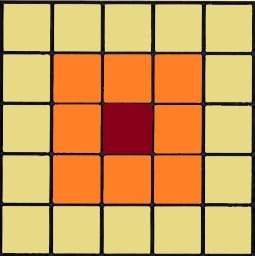
Additionally, As a bonus action, you can move the sphere up to 30 feet. If the sphere is rammed into a creature, that creature makes the same saving throw against the sphere’s damage, and the sphere stops moving for this turn. This can be done on every one of your turns while Flaming Sphere remains active.
The sphere can move over barriers of up to 5 feet tall and can jump across pits up to 10 feet wide. It also ignites flammable objects it touches that are not being worn or carried and sheds bright light in a 20-foot radius and dim light for an additional 20 feet.
Basically, Flaming Sphere has two distinct damage triggers:
- The “Ram” (Bonus Action): You can use your Bonus Action to slam the sphere into a creature. The creature must make a Dexterity saving throw, taking 2d6 Fire damage on a failure or half as much on a success.
- The “Burn” (Passive): Any creature that ends its turn within 5 feet of the sphere must make the same Dexterity saving throw, taking the same damage.
How did Flaming Sphere change in the 2024 PHB?
Flaming Sphere didn’t change much in the transition from 2014 to 2024. The key changes are:
- Clarified “ramming”: The wording changed from “ram the sphere into a creature” to “move the sphere into a creature’s space.” This clarifies that the sphere enters the target’s grid square before stopping, rather than just hitting them from the side.
- Sorcerers get access (officially): In the 2014 Player’s Handbook, this spell was exclusive to Druids and Wizards. While TCoE gave Sorcerers Flaming Sphere as an optional rule (pg. 65), it has been oficially added to the core Sorcerer spell list in the 2024 PHB.
- Simplified components: The material components changed from “a bit of tallow, a pinch of brimstone, and a dusting of powdered iron” to a simple “ball of wax.”
Spell Rating: Flaming Sphere
Overall: 🔥 B-Tier (Reliable Sustained Damage)
Contextual Performance (1-10)
-
Combat: 7/10. Flaming Sphere is a solid spell at Level 3. While it doesn’t offer the burst damage of Scorching Ray, it provides consistent damage round over round. For classes like Druids (who may lack good ranged attack cantrips) or Wizards conserving slots, turning a Bonus Action into ~5.8 expected damage every turn is excellent value.
Flaming Sphere vs. Scorching Ray (Level 2 Slot)
Spell Action Economy Avg. Dmg (Instant) Avg. Dmg (3 Rounds) Scorching Ray 1 Action 14.6 14.6 Flaming Sphere 1 Action + B. Actions 5.8 (Ram only) 17.4 (Ram x3) F. Sphere (Optimal) 1 Action + B. Actions 11.6 (Ram + End Turn) 34.8 (Ram x3 + End Turn x3) Assumptions: Calculations use a standard 65% hit/fail chance, accounting for critical hits on attacks and half damage on successful saves, with the “Optimal” scenario assuming a single target takes damage from both the bonus action ram and ending its turn in the sphere.
As shown above, Flaming Sphere overtakes Scorching Ray in total damage output by round 3 if you only ram. If you can force the enemy to end their turn next to the sphere (the “Optimal” row), it out-damages Scorching Ray immediately in the second round (11.6 vs 14.6 is close, but by round 2 Flaming Sphere wins easily).
-
Exploration: 3/10. It sheds light and can burn through wooden doors or webs. It can also hover over pits, making it a decent tool for triggering traps safely. It’s kind of expensive to spend a Level 2 spell slot on burning a bunch of stuff and providing light, but it might be your best option if you’re in a rush for some reason.
-
Social: 1/10. No social utility.
Core Metrics (1-10)
-
Raw Power: 6/10. 2d6 damage isn’t high, but the “half damage on save” ensures it rarely does nothing. Its power comes from accumulation, not burst. If combat is unlikely to last at least 3 rounds, you’re probably better off casting something else.
-
Versatility: 6/10. It functions as a light source, a damage dealer, and a soft area-denial tool. It’s most useful in dynamic fights where enemies will be scattering, but don’t have much room to roam (e.g., enclosed 30-60-foot wide rooms).
-
Efficiency: 6/10. A single 2nd-level slot can theoretically deal 20d6+ damage over a combat encounter if maintained, but that’s extremely unlikely to actually happen. While you mostly won’t have anything else to do with your Bonus Action as a spellcaster with access to this spell, it does compete for your Concentration against superior spells, like Web. Great efficiency in a long fight, but still a significant opportunity cost to use it.
-
Upcast Scaling: 2/10. It gains 1d6 per slot level. While not terrible, upcasting it competes with Fireball (3rd level), Wall of Fire (4th level) or Conjure Elemental (5th level), which are generally superior options.
Check out my comprehensive guides on the:
Playstyle and Synergy
-
Playstyle: Flaming Sphere is a “Bonus Action Blaster.” You cast it round 1, then spend subsequent turns using your Action to cast other spells, while your Bonus Action slams the sphere into enemies.
-
Party Synergy: High. It works exceptionally well with “Grappler” allies. If a Fighter grapples an enemy and holds them next to the sphere, the enemy takes damage automatically at the end of their turn, effectively doubling the sphere’s damage output.
Player Tip: The “Indestructible Remote Torch”
I played in a session where my party refused to enter a pitch-black cavern because we could hear chittering sounds echoing from the ceiling (a classic Spider ambush setup). We were at a stalemate; nobody wanted to walk in holding a torch and get bitten.
I cast Flaming Sphere at the very edge of the darkness and used my Bonus Action to roll it 30 feet into the center of the room. Because the spell sheds Bright Light in a 20-foot radius, it instantly illuminated the three Giant Spiders waiting above us. I rammed one immediately, ruining their stealth advantage. Don’t just think of this spell as damage; treat it as an expendable, remote-controlled drone that lights up the battlefield while you stay safely behind cover.
What Are the Rules for Flaming Sphere in 5e?
The rules for Flaming Sphere in DnD 5e are as follows:
-
A creature can take damage from Flaming Sphere twice in one round of combat. If a creature is rammed by Flaming Sphere during the caster’s turn, and then remains in range of it until the end of their turn, they will take damage from the spell both times.
-
A creature can walk into, near, and through Flaming Sphere without taking damage. We have Sage Advice confirmation that a creature can walk into/through Flaming Sphere without taking damage.
In other words, Flaming Sphere cannot be used to physically block creatures. And that does make sense logically — Flaming Sphere is a 5-foot sphere, occupying a volume of 65.45 cubic feet. A 5-foot cube occupies 125 cubic feet. Medium and small creatures can definitely limbo their ways beneath the space between the Flaming Sphere and the floor.
A creature can even be shoved into FS without taking damage. As Jeremy Crawford clarifies, Flaming Sphere only does damage “at the end of a turn or when used to ram someone” — at no other time.
-
Flaming Sphere ends beside a creature after ramming it into them. Flaming Sphere does not move onto the space occupied by the creature it rams into; it ends beside the creature, from whichever side it approached.
It’s a little unclear whether a player can end their turn on the same space as Flaming Sphere, but the fact that they can move through its space seems to suggest that they should be able to. However, it is clear that Flaming Sphere must be conjured in an unoccupied space.
-
Flaming Sphere only deals damage when it rams into a creature. Not when it moves past a creature. This means it can only be used to damage one creature per turn when the ram effect is used.
-
Cover from Flaming Sphere is dependent on your location relevant to it. “A target can benefit from cover only when an attack or effect originates on the opposite side of the cover” (PHB 196).
In other words, a creature can get a bonus to their Dexterity saving throw against Flaming Sphere (or avoid its effect entirely) if there’s cover between it and the sphere.
-
Flaming Sphere can be conjured in the air. As this Sage Advice thread puts it, “flaming sphere has no means of flight, yet the spell doesn’t stop you from creating the sphere in the air. If you do, it falls.”
With a 60-foot range, this does open up the possibility of casting Flaming Sphere on a surface above the caster.
-
Allies also take damage from Flaming Sphere. “Any creature” means that allies are also subject to making a Dex save at the end of their turns if they’re in range of Flaming Sphere.
-
Ramming a creture with Flaming Sphere involves the same saving throw and deals the same damage as the spell’s persistent area of effect damage. Clarified in this Sage Advice thread.
-
Flaming Sphere can be moved outside of its initial 60-foot range. “If a spell has movable effects, they aren’t restricted by its range unless the spell’s description says otherwise” PHB 2024, pg. 236).
-
You don’t need to see where you move Flaming Sphere. Here’s Sage Advice confirmation that you can use your bonus action to move Flaming Sphere to a space you can’t see.
How to Use Flaming Sphere in 5e
Here are a few ways to use Flaming Sphere in DnD 5e:
-
Trap enemies between Flaming Sphere and allies. While it’s sad that the sphere can’t physically block creatures, there is another way to trap enemies with this spell.
If you position the sphere so that it’s behind enemies who are fighting your melee party members, the enemies will have to make a decision: remain where they are and take fire damage from Flaming Sphere, or move and trigger opportunity attacks from your allies.
Either way, you just increased your party’s damage for the round.
-
Protect an area. If you need to protect an NPC or prevent enemies from standing near something, Flaming Sphere can be a great spell for the occasion. Most creatures don’t like hanging out near/approaching fire if they can help it.
-
Pair with grappling. One of the best ways to consistently trigger Flaming Sphere’s persistent, end-of-turn damage is to have an ally grapple an enemy within range of the sphere. They just have to be careful about how they orient themselves relative to the sphere, to ensure that they don’t take friendly fire.
-
Pair with restraining effects. 16 spells in DnD 5e cause the restrained condition. Entangle, Ensnaring Strike, Snare, Maximilian’s Earthen Grasp, and Web are the level-appropriate spell options that work nicely with Flaming Sphere.
Web is a particularly nice spell to pair it with if you can work with another caster (both spells require concentration). The restrained effect can hold multiple enemies in place near the flames. And when you decide to ram a webbed creature, they’ll take an additional 2d4 fire damage (and be freed from the webs, but hey, still fun).
-
Send it around corners. The fact that you can move Flaming Sphere into spaces that you can’t see is a nice advantage of the spell. Especially if you have allies who do have vision of the battlefield and can help you direct the sphere intelligently.
Another fun tip: If you pair Flaming Sphere with Find Familiar, you can use your familiar to scout ahead for vision. It requires an action to see through your familiar’s vision, and a bonus action to move Flaming Sphere — the perfect combo for a long-distance, remote fireball.
Enemies won’t even know how to react, let alone who to attack. That pandemonium is something your party should be able to take advantage of, even if the spell doesn’t do a bunch of outright damage in the initial assault.
-
Illuminating the dark. In dungeons without darkvision, send the sphere ahead 60 feet. It sheds bright light, allowing your party to see threats before they walk into ambush range, effectively acting as a scouting drone.
Is Flaming Sphere 5e a Good Spell?
Yes, Flaming Sphere is a good spell. While it can be tricky to consistently land this spell’s area of effect damage, the continuous extra damage at the cost of a bonus action each round is nice. Plus, making good use of positioning can put your enemies between a rock and a…fiery place.
That said, Flaming Sphere can be frustrating to use if the space isn’t conducive to boxing in enemies. Or if enemies and your allies are spread in such a way that it’s not possible to reliably pin foes down.
The spell’s biggest weakness is that it requires Concentration. At higher levels (even level 5+), it struggles to compete with powerful control spells like Hypnotic Pattern. Once you gain access to 4th-level spells, Flaming Sphere often retires from your preparation list because the “Opportunity Cost” of concentrating on a mere 2d6 damage becomes too high.
Flaming Sphere 5e Compared to Fireball
3rd-level Wizards might wonder whether they’re better off skipping Flaming Sphere, what with Fireball becoming available in just two levels. While Fireball is the premier AoE blasting spell for a big chunk of a campaign, it doesn’t make Flaming Sphere completely useless.
For starters, Flaming Sphere has a 1-minute duration and can be used to control the battlefield, force enemies into difficult decisions, and make safe attacks from around corners. Not to mention that, if used for the full duration against enemies who can’t move, Flaming Sphere can easily out-damage Fireball overall.
That being said, Fireball’s massive area of effect, range, and upfront damage are still attractive. If you’re looking for the better straight-up damage spell, Fireball wins. If you want more nuance and control, go with Flaming Sphere.
Picking both isn’t the best idea, since they’re both fire spells with Dexterity saves. Unless you’re building a fully thematic fire mage — then it’s a great idea.
DnD 5e Flaming Sphere FAQ
-
Can you hit a creature twice with Flaming Sphere? Yes, you can damage a creature twice in a single round. If you use your Bonus Action to ram the sphere into a creature, it makes a saving throw immediately. If that creature then stays in that space and ends its turn there, it must make the saving throw again.
-
Does Flaming Sphere block movement? No, Flaming Sphere does not physically block movement. While it occupies a 5-foot space, it is composed of fire, not solid matter. Creatures can move through the sphere’s space, though they risk taking damage if they end their turn inside it. It cannot be used to “plug” a doorway in the same way a solid object or a creature would.
-
Do allies take damage from Flaming Sphere? Yes, allies take damage from Flaming Sphere. The spell description states that “Any creature” that ends its turn within 5 feet of the sphere must make a saving throw. The fire does not distinguish between friend or foe, so you must be careful when positioning the sphere near your party’s front-line fighters.
2014 Flaming Sphere (Legacy Version)
The text below covers the version of Web found in the 2014 Player’s Handbook. I have preserved this section for players running legacy campaigns or using older modules that haven’t updated to the 2024 rule set.
If you are playing with the 2024 rules, use the guide at the top of this page.
As a bonus action, you can move the sphere up to 30 feet. If you ram the sphere into a creature, that creature must make the saving throw against the sphere’s damage, and the sphere stops moving this turn.
When you move the sphere, you can direct it over barriers up to 5 feet tall and jump it across pits up to 10 feet wide. The sphere ignites flammable objects not being worn or carried, and it sheds bright light in a 20-foot radius and dim light for an additional 20 feet.
At Higher Levels. When you cast this spell using a spell slot of 3rd level or higher, the damage increases by 1d6 for each slot level above 2nd.
Casting Time: 1 action
Range: 60 feet
Components: V, S, M (a bit of tallow, a pinch of brimstone, and a dusting of powdered iron)
Duration: Concentration, up to 1 minute
School: 2nd-level conjuration

Matt Zane
Author, DnD Lounge