Choose a manufactured metal object, such as a metal weapon or a suit of Heavy or Medium metal armor, that you can see within range. You cause the object to glow red-hot. Any creature in physical contact with the object takes 2d8 Fire damage when you cast the spell. Until the spell ends, you can take a Bonus Action on each of your later turns to deal this damage again if the object is within range.
If a creature is holding or wearing the object and takes the damage from it, the creature must succeed on a Constitution saving throw or drop the object if it can. If it doesn’t drop the object, it has Disadvantage on attack rolls and ability checks until the start of your next turn.
Using a Higher-Level Spell Slot. The damage increases by 1d8 for each spell slot level above 2.
Casting Time: Action
Range: 60 feet
Components: V, S, M (a piece of iron and a flame)
Duration: Concentration, up to 1 minute
School: Level 2 Transmutation
Who can cast Heat Metal? Bards, Druids, and Artificers have Heat Metal on their class spell lists. Forge Domain Clerics get Heat Metal for free and always have it prepared.
| Category | Score |
|---|---|
| Combat Rating | 8/10 |
| Exploration Rating | 2/10 |
| Social Rating | 1/10 |
| Raw Power | 8/10 |
| Versatility | 2/10 |
| Efficiency | 10/10 |
| Upcast Scaling | 7/10 |
Learn more about how my spell rating system works
Heat Metal 5e
In the 2014 edition, Heat Metal was infamous for the “Cook and Book” strategy — casting the spell on a heavily armored enemy and running away while they slowly burned to death with no save. In the 2024 Player’s Handbook, this spell remains one of the most potent single-target debuffs in the game, but it has received a critical stealth nerf regarding range.
Below, I break down the new limitations on maintaining the damage, analyze the math of guaranteed damage versus attack rolls, and determine if this spell is still the ultimate “Boss Killer.”

What Does Heat Metal Do in 5e?
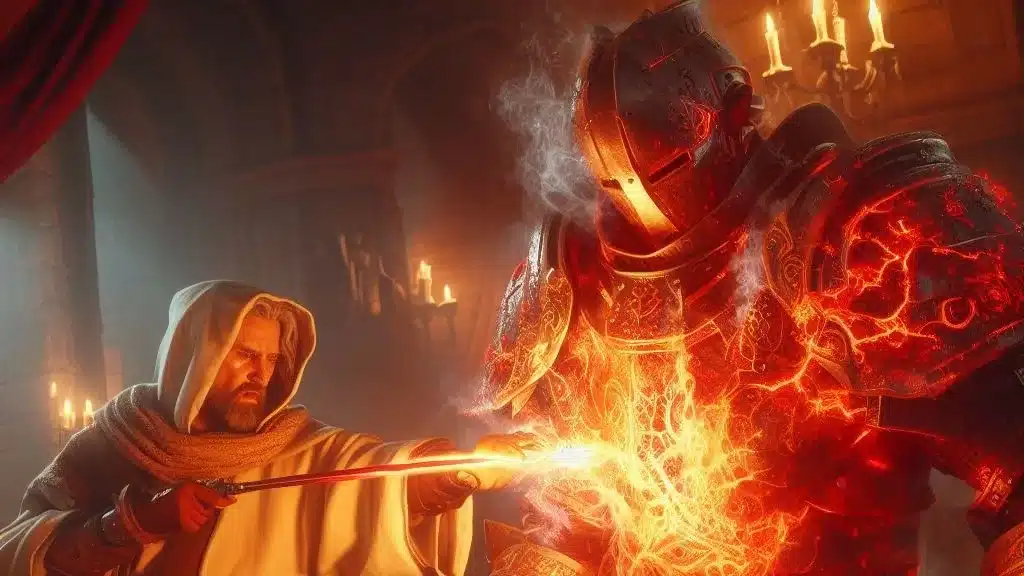
Heat Metal targets a manufactured metal object you can see within 60 feet. Upon casting, any creature touching the object automatically takes 2d8 Fire damage (average 9). There is no attack roll or saving throw to avoid this initial damage. On subsequent turns, you can use your Bonus Action to deal the damage again.
This is the tricky part:
-
The drop mechanic: The creature must make a Constitution saving throw. On a failure, it must drop the object if possible (e.g., a weapon). If it succeeds, it can choose to keep holding it. There’s nothing to stop it from choosing to drop the item on its turn, however — that’s a free action (PHB 2024, pg. 361).
-
The debuff: If the creature does not drop the object (either because it succeeded on the save and chose to hold it, or because it is armor that cannot be dropped instantly), it suffers Disadvantage on attack rolls and ability checks until the start of your next turn.
A full duration heat metal will deal an impressive 20d8 fire damage over 10 rounds of combat — not bad for a second-level spell. Heat Metal can also be upcast to deal an additional 1d8 damage each time it deals damage — both on the initial cast and all subsequent bonus actions used to deal additional damage.
How did Heat Metal change in the 2024 PHB?
While the core function of Heat Metal remains the same, the 2024 update introduced a specific restriction to prevent the “Cook and Book” exploit:
Range check on damage. In the 2014 version, you only needed to be within range to cast the spell. Once cast, you could run miles away, and the damage would continue as long as you held Concentration. The 2024 text explicitly states you can deal damage on later turns only “if the object is within range” (60 feet).
Spell Rating: Heat Metal
Overall: 🔥 B-Tier (Situational God-Slayer)
Contextual Performance (1-10)
-
Combat: 8/10. When this spell works, it really works. Against a target wearing metal armor (like a Helmed Horror or a high-level Paladin NPC), it deals guaranteed damage and imposes permanent Disadvantage on attacks (since it takes 1 minute to doff Medium armor and 5 minutes to doff Heavy armor).
Against beasts or creatures who don’t wear metal, it’s 100% useless.
-
Exploration: 2/10. Limited utility. A generous DM might allow you to weaken a metal lock or hinge, making it easier to break with a Strength check or weapon attack. That’s not RAW, to be clear, but some DMs may reward clever thinking (and the sacrifice of a Level 2 spell slot) if you don’t abuse it too often.
-
Social: 1/10. Casting a spell to burn someone is an act of violence, not a social tactic.
Core Metrics (1-10)
-
Raw Power: 8/10. Dealing 2d8 (9) damage might seem low compared to Scorching Ray (6d6, avg 21 when it hits, average 13.65 assuming a 65% hit chance), but Scorching Ray requires attack rolls, only deals damage on one round, and doesn’t impose any negative conditions on the target. Heat Metal deals guaranteed damage. Over 3 rounds, Heat Metal deals 27 unavoidable damage while leaving your Action free for other spells or actions.
Plus, it helps your party take less damage — an attacker with disadvantage will land attack rolls much less often. It also makes it harder for a creature to escape a grapple, since it also has disadvntage on skill checks (as long as your party’s grappler is okay getting burned while bear-hugging molten metal).
-
Versatility: 2/10. This spell has a binary fail state: if the enemy has no metal, the spell does nothing. You cannot prepare this spell blindly; it requires knowledge of what you are fighting. That said, in the rare cases where you’d prefer to disarm a creature from a distance, Heat Metal does offer some versatility.
-
Efficiency: 10/10. This is the gold standard for efficiency. It costs one spell slot, deals damage using only a Bonus Action, requires no d20 rolls to hit, and imposes a debilitating debuff (Disadvantage) that bypasses Legendary Resistances (as long as the target is wearing the metal).
-
Upcast Scaling: 7/10. Scaling by 1d8 per level is excellent for a damage-over-time spell. A 3rd-level Heat Metal deals 3d8 (13.5) guaranteed damage per round. This outpaces many other DOT spells because it never misses. Does it stack up against higher-level single-target spells? Yes, in my opinion, thanks to the guaranteed damage and consistent debuff.
Playstyle and Synergy
-
Playstyle: This is a “Controller/Striker” hybrid spell. It shuts down martial bosses by imposing Disadvantage while slowly cooking them.
-
Party Synergy: High. By imposing Disadvantage on the enemy’s Ability Checks, you make them highly susceptible to being unable to escape Grapples from your martial allies (as long as they’re okay taking the fire damage, too). Disadvantage on attack rolls means less incoming damage as well.
Player Tip: The “Range Leash”
While the “Cook and Book” strategy no longer works as well as it used to, the general concept is still correct. The spell doesn’t end if you’re more than 60 feet from the target; you just can’t auto-damage it.
That means if you have 30 feet of movement, you can stand 75 feet away at the start of your turn, run 15 feet closer to the target, then back up 15 feet again — still putting plenty of distance between you and the foe you’re slow roasting.
How to Use Heat Metal in 5e
Heat Metal can feel downright overpowered when you use it in the right situations. Here are some fun applications of the spell:
-
Nullifying heavily-armored BBEGs. Much of the DM antagonism around Heat Metal stems from how dang easy it makes boss fights where the boss is reliant on metal armor. A full minute of disadvantage while taking unavoidable 2d8 fire damage each round is incredibly strong.
The only trick is to remember that Heat Metal requires concentration, so you’ll want to keep yourself protected from damage and other interrupting effects in order to ensure that the spell lasts for its maximum duration.
-
Forcing someone to drop an important item. A thief is running away with a stolen metal object; a jailer is taunting you with the key as he stands before your cell; an evil queen haughtily holds out her iron scepter as proof of her divine mandate to rule. These are all situations where using Heat Metal can be highly effective for more than just its raw damage potential.
Cast this on a boss’s weapon or arcane focus. They must make a Constitution save. If they fail, they drop it. If they succeed, they hold onto it but suffer Disadvantage on attacks and checks. Either way, you have significantly debuffed them.
-
Running away. While it seems sad to use such a devastating spell defensively, Heat Metal can be the perfect thing to get out of a bad situation. It takes a long time to remove armor (which is what most reasonable creatures will do), and even if it is hellbent on catching you, the creature will have to contend with disadvantage on attack rolls and ability checks.
-
Breaking Concentration. Because the damage is guaranteed (no roll to hit), this is an excellent tool for forcing enemy spellcasters to make Concentration saves. If an enemy Cleric is concentrating on Spirit Guardians and wearing a metal breastplate, Heat Metal forces a DC 10 Concentration check immediately, and another one every time you use your Bonus Action.
-
Melting doors shut. The spell doesn’t indicate a specific heat, nor does it state that heated metal objects are permanently damaged or even transformed in any way as a result of the spell. As such, we must assume that they are not (in the case of weapons and armor, at least).
However, a DM who rewards quick and creative thinking may allow for a player to slam a door shut and then use Heat Metal to fuse the hinges or destroy the keyhole. This is NOT RAW, so if your DM doesn’t allow it, that’s why.
What Are the Rules for Heat Metal in 5e?
Heat Metal is a hotly contested (get it?) spell, so let’s cover the nitty-gritty. The rules for Heat Metal in the 2024 Player’s Handbook are as follows:
-
The damage happens first. The creature doesn’t get a chance to drop the item before the damage occurs. The description states that the initial damage precedes the Constitution saving throw, so even if they drop the item, they still take that initial damage.
-
A failed save results in a dropped item, but the creature can also choose to drop the item. Any creature or player can drop or pick up an object without expending an action ((PHB 2024, pg. 361)).
If you use Heat Metal on a weapon, and the creature succeeds on their save (meaning they can continue holding onto the item), they can still decide to drop the weapon on their turn without expending an action. It’s just they don’t reflexively drop the item without making a conscious decision to do so.
-
Damage requires proximity. Unlike the 2014 version, you cannot deal the Bonus Action damage if the target moves more than 60 feet away from you. However, the spell does not end if they move out of range; you simply cannot trigger the damage that turn. If you move back in range, you can resume burning them.
-
The item stays hot if you keep concentrating. Regardless of whether the creature drops the item, Heat Metal continues as long as your concentration does.
-
You don’t have to deal damage with Heat Metal every turn. You must use your bonus action in order for Heat Metal to do damage. Some DMs try to turn the heated metal into a weapon against the players — this only works if the player foolishly uses their bonus action to heat the metal while the creature is hugging a party member (or the caster herself!)
-
Whether a specific armor is made of metal is up to DM discretion. Not all Heavy or Medium armor is necessarily made of metal.
-
It takes 1 minute to Doff Medium Armor and 5 minutes to Doff Heavy Armor (PHB 219). This means that it’s impossible for a creature whose armor is targeted with Heat Metal to remove their armor before the spell would end anyway (since Heat Metal has a maximum of a 1-minute duration).
-
It’s possible to use Heat Metal on bone. Calcium is a metal, so Heat Metal should work on bone. However, the spell stipulates that the metal must be manufactured, so the bone would have to be manipulated in some way. For example, a bone weapon or carved bone armor is fair game, but the compound fractured femur of an Ogre is not.
Of course, a DM may rule that the “manufactured” stipulation refers to the material used to craft the object rather than the object itself, in which case bone would not be an acceptable target under any circumstances.
-
Heat Metal does not give a weapon bonus fire damage. Heat Metal’s damage only happens on the initial cast and when the caster uses a bonus action on their turn. So heating a metal weapon that an ally holds will only hurt them and possibly disarm them.
That said, you can use the “Ready” action to prepare Heat Metal for the moment an ally’s weapon strikes a foe, at which time you can use your Reaction to cast Heat Metal instantly (or ignore the trigger) (PHB 2024, pg. 372).
If it’s a melee weapon, your ally will also take damage, though. If it’s a projectile, you should be able to get away with Heat Metal adding damage the moment the missile hits the enemy. This is really not how the spell is meant to be used, though, and it’s far from optimal.
-
Heat Metal gives no explicit indication on maximum size. While the spell’s largest example is a “suit of armor,” the description never outright gives a size that Heat Metal can affect. It’s up to DM’s to determine what “an object” is (while also keeping in mind the spell’s maximum range of 60 feet).
-
Wearing armor that’s affected by Heat Metal gives you disadvantage on attack rolls ability checks. Some players think that the disadvantage only applies if Heat Metal targets a weapon, since the line about disadvantage directly follows the line about making a saving throw to drop a weapon.
However, the disadvantage applies to any creature who is wearing or holding the heated metal. Confirmed on Sage Advice.
@DeadOnToilet You have disadvantage while you're wearing the heated metal. Your best bet is to break the concentration of the spellcaster.
— Jeremy Crawford (@JeremyECrawford) November 17, 2014
What Can I Target With Heat Metal 5e?
You can target any manufactured metal with heat metal. Depending on your DM, this may or may not include bone. It definitely does not include raw, unworked bone, as that is not manufactured. Same goes for raw iron ore and the like.
Additionally, any players hoping to be cheeky by targeting the iron in a foe’s blood will be sadly disappointed. The iron in a hobgoblin’s hemoglobin is no more manufactured than human skin is synthetic.
Is Heat Metal 5e a Good Spell?
Yes, Heat Metal is a solid damaging spell for 2nd-level. 20d8 (90) total fire damage, increasing by 10d8 (45) for each level above the first, is absolutely massive. So why isn’t every caster running around doing nothing but heating metal?
Well, not every enemy is wearing metal armor. And while Heat Metal is okay as a quick disarm, it’s not nearly as impactful to use on weapons as it is on armor. Additionally, fire resistance and immunity are some of the most common among monsters in the DnD universe, limiting the spell’s potential targets even further.
Heat Metal is a perfectly balanced spell because it’s hugely situational. If you don’t run into many metal-clad enemies, Heat Metal will feel useless; if that’s all you’re facing, you’ll feel like a god.
Heat Metal 5e DM Tips
The biggest tip for DMs dealing with Heat Metal is to not get frustrated when players make your heavily-armored BBEG look like a chump. Instead, you can do a tad bit of metagaming to try to break the caster’s concentration using minions or other terrain effects.
After all, if the BBEG is getting melted in her suit of armor, it’s not unreasonable that she’d call out for her goons to tackle the person responsible.
Also, with the new range stipulation, you can just try to put distance between yourself and the caster (with mooks in the way, so they can’t approach without taking opportunity attacks).
When using Heat Metal against players, don’t go easy on them. If they can’t figure out the same concentration-breaking trick as your BBEG and her minions, that’s on them. Of course, you could always drop in an NPC in to mention that tip if players aren’t catching on fast enough.
DnD 5e Heat Metal FAQ
-
Can you target a warforged with heat metal? No, you cannot target a warforged with heat metal. The spell heat metal specifically states that it must target an object that is not being worn or carried, and a warforged is a living creature, not an object.
-
Does heat metal work on metallic dragons? No, heat metal does not work on metallic dragons or any other living creatures. The spell is designed to target and affect metal objects, not creatures, even if those creatures have metallic bodies.
-
Can heat metal melt metal? No, heat metal does not have the capability to melt metal. It can heat a metal object to cause damage, but it doesn’t generate enough heat to melt metal, which typically requires much higher temperatures.
-
Does heat metal cause a weapon to deal more damage? No, heat metal does not cause a weapon to deal more damage. It affects the metal object itself, not the weapon that might be made from metal. Its primary effect is to inflict damage on the creature wearing or holding the heated metal object.
-
Does heat metal work on armor? Yes, heat metal can work on armor if the armor is made of metal. It targets and heats the metal components of the armor, causing the creature wearing it to take damage and potentially drop or remove the heated armor to avoid further harm. This applies to heavy or medium armor that is made of metal materials (so not hide armor or any light armor).
2014 Heat Metal (Legacy Version)
The text below covers the version of Heat Metal found in the 2014 Player’s Handbook. I have preserved this section for players running legacy campaigns or using older modules that haven’t updated to the 2024 rule set.
If you are playing with the 2024 rules, use the guide at the top of this page.
If a creature is holding or wearing the object and takes the damage from it, the creature must succeed on a Constitution saving throw or drop the object if it can. If it doesn’t drop the object, it has disadvantage on attack rolls and ability checks until the start of your next turn.
At Higher Levels. When you cast this spell using a spell slot of 3rd level or higher, the damage increases by 1d8 for each slot level above 2nd.
Casting Time: 1 action
Range: 60 feet
Components: V, S, M (a piece of iron and a flame)
Duration: Concentration, up to 1 minute
School: 2nd-level transmutation

Matt Zane
Author, DnD Lounge