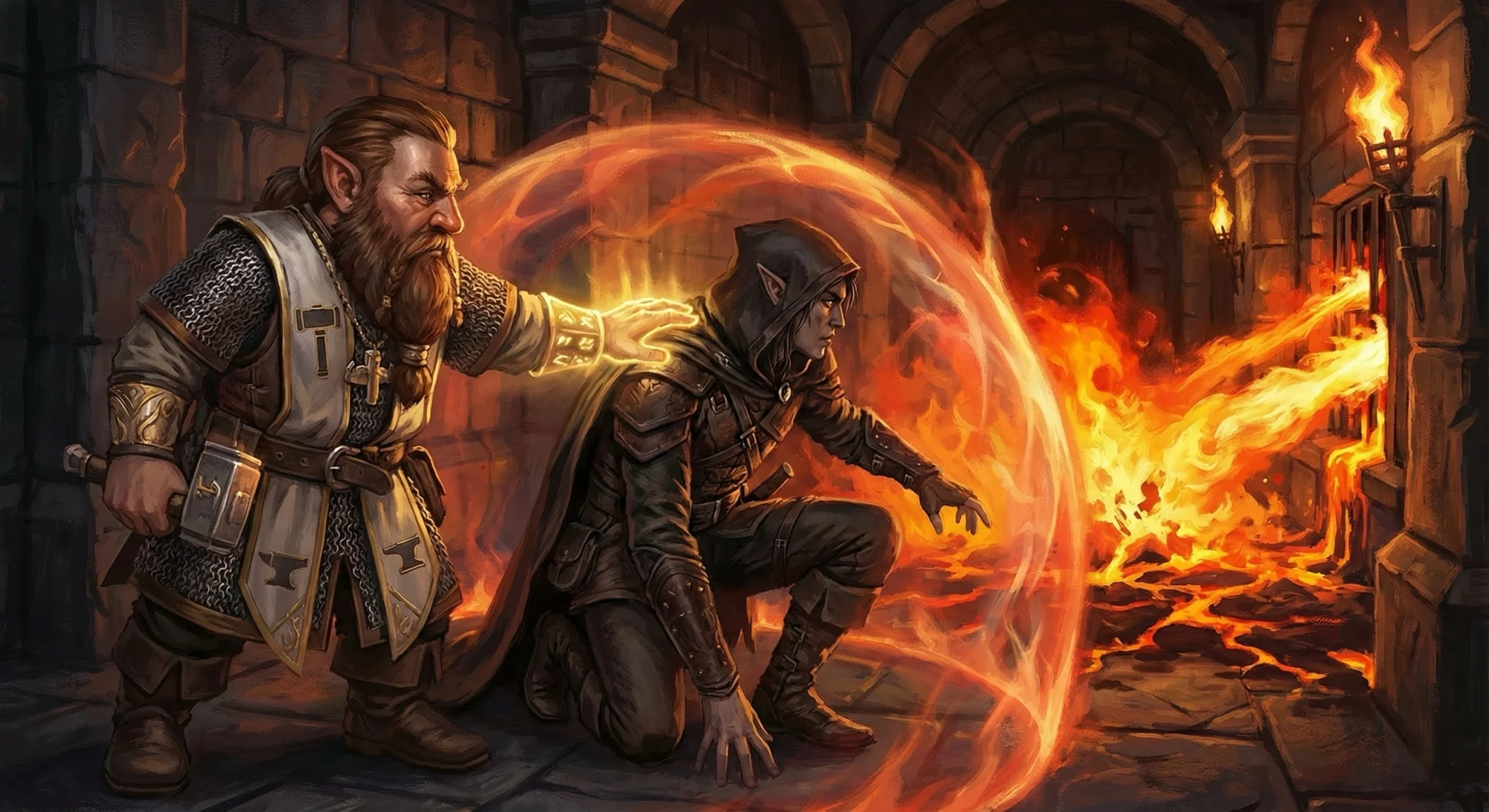
You touch a willing creature and choose a damage type: Acid, Bludgeoning, Cold, Fire, Lightning, Necrotic, Piercing, Poison, Radiant, Slashing, or Thunder.
When the creature takes damage of the chosen type before the spell ends, the creature reduces the total damage taken by 1d4. A creature can benefit from this spell only once per turn.
Casting Time: 1 action
Range: Touch
Components: V, S
Duration: Concentration, up to 1 minute
School: Abjuration Cantrip
Who can cast Resistance? Clerics, Druids, and Artificers have Resistance on their class spell lists.
| Category | Score |
|---|---|
| Combat Rating | 2/10 |
| Exploration Rating | 4/10 |
| Social Rating | 1/10 |
| Raw Power | 2/10 |
| Versatility | 3/10 |
| Efficiency | 3/10 |
| Upcast Scaling | 1/10 |
Learn more about how my spell rating system works
Resistance 5e
In the 2014 rules, Resistance was the forgotten sibling of Guidance. While Guidance helped with skill checks constantly, Resistance offered a one-time bonus to a saving throw and required Concentration, making it practically useless in the heat of combat. In the 2024 update, Wizards of the Coast completely overhauled the spell.
Resistance has transitioned from a saving throw buff to a damage mitigation tool. Below, I analyze the math behind this new damage reduction mechanic and determine if it is finally worth picking up (spoiler: it’s usually not).
What Does Resistance Do in 5e?
Resistance is a proactive defense spell. You touch a willing creature and declare a specific damage type (like Fire or Bludgeoning). For the next minute, whenever that creature takes damage of that specific type, they subtract 1d4 from the total.
The target can only reduce damage one per turn, and the spell requires Concentration to maintain.
How did Resistance change in the 2024 PHB?
The 2024 update changed the fundamental identity of the spell from a “Save Booster” to a “Damage Shield.” The key changes are:
- Effect overhaul: In 2014, it added 1d4 to a Saving Throw. In 2024, it reduces incoming damage by 1d4.
- Duration utilization: In 2014, the spell ended immediately after the target used the die once. In 2024, the spell lasts for the full duration (up to 1 minute), allowing for repeated uses.
- Material components: The 2014 version required a miniature cloak. The 2024 version has removed the material component requirement.
- Usage limit: The new version applies a “once per turn” limit to the damage reduction.
Spell Rating: Resistance
Overall: 🛡️ F-Tier (Niche Mitigation)
Contextual Performance (1-10)
-
Combat: 2/10. The opportunity cost of this spell is simply too high. It requires Concentration, which means a Cleric cannot run Bless, Spirit Guardians, or Bane while using this. Reducing damage by an average of 2.5 once per turn is mathematically insignificant compared to the damage prevented by killing enemies faster (via Bless) or controlling them (via Web or Entangle).
The Math Problem (Mitigation vs. Action Economy):
Scenario: A Goblin attacks an ally for 1d6 + 2 (5.5 avg) damage.
Resistance reduces the damage by 2.5 on average. Ally takes 3 damage.
-
Exploration: 4/10. This is the Resistance’s only real purpose. If the party must walk through a hallway of magical fire, or wade through a pool of acid, Resistance provides some damage mitigation. Since these environmental hazards usually tick once per round, the “once per turn” limit isn’t a hindrance.
-
Social: 1/10. Maybe Resistance can help you reduce Poison damage in a Princess Bride type scenario where you’re not sure if you or your adversary is about to drink poison? But really, that’s a stretch.
While 2.5 damage reduction sounds okay for a cantrip, it requires your Action to cast and your Concentration to hold. In Tier 1 play, a simple attack with a mace (1d6+2) contributes more to ending the fight than preventing 2.5 damage.
Core Metrics (1-10)
-
Raw Power: 2/10. 1d4 damage reduction is minor. At Level 1, it might negate cut incoming damage in half. By Level 5, when enemies deal 20+ damage per hit, reducing it by 2 is negligible.
-
Versatility: 3/10. You can choose from almost any damage type, which is nice. However, you have to choose before the damage happens. If you pick “Slashing” and the enemy switches to a warhammer (Bludgeoning), the spell does nothing.
-
Efficiency: 3/10. If you can pre-cast this before a combat starts without using a spell slot, it is “free” HP. However, once initiative is rolled, spending an Action to set this up is highly inefficient. In out-of-combat scenarios (e.g., reducing long-term damage over time or trap damage), Resistance is fairly efficient, as long as you don’t need your Concentration for anything else.
-
Upcast Scaling: 1/10. This spell does not scale.
Check out my comprehensive guides on the:
Playstyle and Synergy
-
Playstyle: Use this as a “Hazard Suit.” Do not use it as combat armor. It is best used when the Rogue is disarming a trap that might spray acid, or when the Barbarian has to retrieve an item from a bonfire.
-
Party Synergy: Low. It conflicts with almost every other (much superior) buff spell in the game due to the Concentration requirement.
Player Tip: The “DoT” Counter
While Resistance is weak against attacks, it is more effective against Damage over Time (DoT) spells. Spells like Heat Metal, Witch Bolt, or even being swallowed by a monster often deal damage exactly once per turn.
If an ally is suffering from a persistent effect that you cannot dispel, casting Resistance (Fire) on them effectively gives them “Regeneration 2.5” against that specific effect every round for a minute. That adds up to ~25 prevented damage over the full duration, which is decent for a cantrip.
DnD 5e Resistance FAQ
-
Does Resistance stack with the Barbarian’s Rage? Yes, but the order of operations matters. Generally, in 5e, you apply flat bonuses or penalties before applying the multiplication or division of resistance or vulnerability (PHB 2024, pg. 28). If a Raging Barbarian takes 10 Bludgeoning damage and has Resistance cast on them, they first subtract 1d4 (let’s say 2) to get 8, and then Rage halves that to 4.
-
Can I cast Resistance on myself? Yes. The range is Touch, and you can touch yourself. This effectively gives you a small damage shield while you concentrate, though taking damage forces a Concentration check, which risks ending the spell.
-
Does Resistance work on magical damage? Yes. The 2024 rules do not distinguish between “magical” and “nonmagical” damage types for this spell. If you choose Fire, it works on both a mundane torch and a Fireball spell.
2014 Resistance (Legacy Version)
The text below covers the version of Resistance found in the 2014 Player’s Handbook. I have preserved this section for players running legacy campaigns or using older modules that haven’t updated to the 2024 rule set.
If you are playing with the 2024 rules, use the guide at the top of this page.
Casting Time: 1 action
Range: Touch
Components: V, S, M (a miniature cloak)
Duration: Concentration, up to 1 minute
School: Abjuration

Matt Zane
Author, DnD Lounge