You create a floating, spectral force that resembles a weapon of your choice and lasts for the duration. The force appears within range in a space of your choice, and you can immediately make one melee spell attack against one creature within 5 feet of the force. On a hit, the target takes Force damage equal to 1d8 plus your spellcasting ability modifier.
As a Bonus Action on your later turns, you can move the force up to 20 feet and repeat the attack against a creature within 5 feet of it.
Using a Higher-Level Spell Slot. The damage increases by 1d8 for every slot level above 2.
Casting Time: Bonus Action
Range: 60 feet
Components: V, S
Duration: Concentration, up to 1 minute
School: Level 2 Evocation
Who can cast Spiritual Weapon? Clerics have Spiritual Weapon on their class spell list. War Domain Clerics and Oath of Conquest Paladins always have Spiritual Weapon prepared. Divine Soul Sorcerers also have access to Spiritual Weapon.
| Category | Score |
|---|---|
| Combat Rating | 4/10 |
| Exploration Rating | 1/10 |
| Social Rating | 1/10 |
| Raw Power | 5/10 |
| Versatility | 3/10 |
| Efficiency | 4/10 |
| Upcast Scaling | 4/10 |
Learn more about how my spell rating system works
Spiritual Weapon 5e
In 2014, Spiritual Weapon was widely considered a mandatory spell for Clerics. It offered non-concentration bonus action damage, allowing players to stack it with powerhouse spells like Spirit Guardians or Bless. It was the gold standard of action economy efficiency.
In the 2024 update, the spell has received a controversial overhaul. It now requires concentration, fundamentally changing its role in a Cleric’s arsenal. However, to compensate for this heavy cost, its upcasting scaling has been buffed.
Below, I analyze the new math, compare it to the old version, and determine if this former titan of the Cleric spell list is still worth preparing.
What Does Spiritual Weapon Do in 5e?
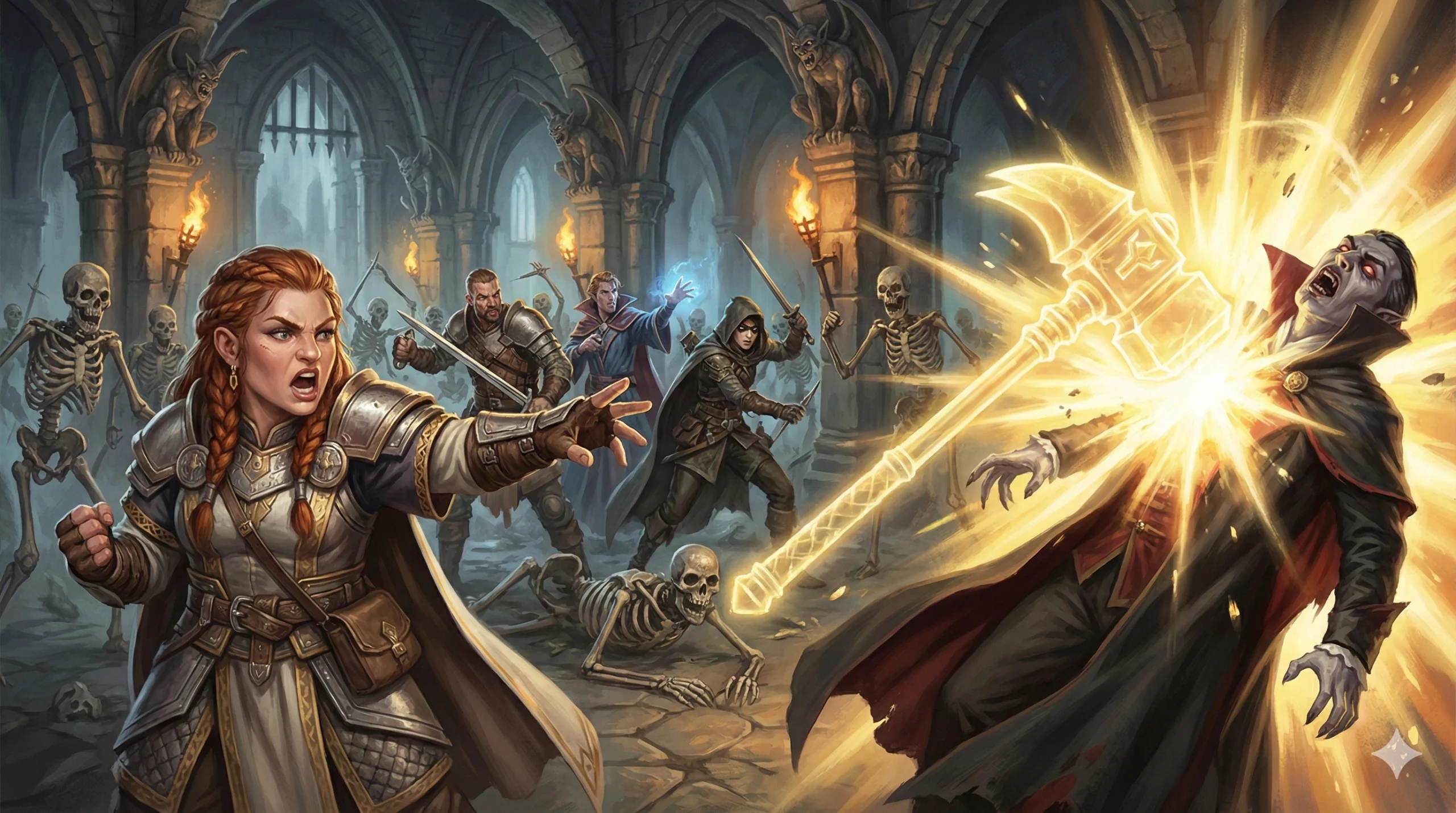
Spiritual Weapon summons a floating, spectral weapon within 60 feet as a bonus action. When you cast it, you can immediately make a melee spell attack against a creature within 5 feet of the weapon. On a hit, it deals 1d8 Force damage plus your Spellcasting Ability Modifier (Wisdom for Clerics).
On subsequent turns, you can use your Bonus Action to move the weapon up to 20 feet and repeat the attack against a creature within 5 feet of it. Spiritual Weapon lasts for 1 minute, which is 10 rounds of combat. Clerics and Paladins who pick this spell up likely have a +3 or +4 spellcasting modifier, making the average damage of Spiritual Weapon 7.5 or 8.5 on hit. Assuming a 65% hit chance, that’s about 4.9 or 5.5 average expected damage.
Upcasting it increases the damage by 1d8 per slot level above 2 (e.g., 2d8 + spellcasting mod at 3rd level, 3d8 + spellcasting mod at 4th level, etc.)
How did Spiritual Weapon change in the 2024 PHB?
The 2024 version of Spiritual Weapon underwent two massive changes that pull the spell in opposite directions regarding power level:
-
Concentration requirement (major nerf): The spell now requires concentration. This prevents it from being stacked with other concentration spells like Spirit Guardians, Bless, or Bane.
-
Improved scaling (small buff): The damage now increases by 1d8 for every slot level above 2nd. In the 2014 version, it only increased by 1d8 for every two slot levels.
Spell Rating: Spiritual Weapon
Overall: 📉 C-Tier (Niche Damage Option)
Contextual Performance (1-10)
-
Combat: 4/10. This score is a significant drop from the 2014 version (which was easily a 9/10). The problem is opportunity cost. Clerics have the best concentration spell list in the game (Bless, Spirit Guardians, Banishment, Holy Aura). Using your concentration to deal 1d8+4 damage per turn is mathematically inferior to hitting multiple enemies with Spirit Guardians or buffing your Great Weapon Master Fighter with Bless.
-
Exploration: 1/10. It is a combat construct with no utility application. It cannot float through walls or carry objects.
-
Social: 1/10. Maybe a cool party trick, but it’s not a helpful spell in social situations.
Core Metrics (1-10)
-
Raw Power: 5/10. At 2nd Level, dealing ~8.5 damage as a bonus action is fine. However, because it now requires concentration, we must compare it to other concentration damage options. Flaming Sphere (Wizard/Druid) deals 2d6 (7) damage, but hits on a failed save and still does half on a success, and can damage multiple creatures. Spiritual Weapon is single-target and does nothing on a miss.
-
Versatility: 3/10. Force damage is excellent, and the 60-foot range is decent. However, the weapon only moves 20 feet per turn. Fast enemies can easily outrun it, leaving your concentration spell stranded on the other side of the battlefield.
-
Efficiency: 4/10. In 2014, this was a 10/10 for efficiency because it used a Bonus Action and didn’t use concentration. Now, it demands your most precious resource (concentration) for mediocre single-target damage. While extra damage on top of other spells or cantrips each turn for only a bonus action is nice, it is still inefficient compared to almost every other Cleric concentration option.
-
Upcast Scaling: 4/10. Sure, it now upcasts better than the 2014 version. But it’s barely worth your Level 2 spell slot now; why would it be worth a higher one for a measly +4.5 damage per slot level?
Playstyle and Synergy
-
Playstyle: This spell is for “Ranged Clerics” or “Backline Paladins” who want to contribute damage from a safe distance without entering melee. It serves as a backup option when you are out of 3rd-level slots for Spirit Guardians.
-
Party Synergy: None. It provides pure damage with no control or buffing elements. Unlike Bless or Bane, it does not help your teammates succeed.
Player Tip: The “Backup” Plan
Don’t prepare Spiritual Weapon thinking it is your “go-to” combat spell anymore. That title belongs to Spirit Guardians.
However, keep Spiritual Weapon prepared for fights where you cannot get into melee range. If you are fighting flying enemies or enemies on ledges, Spirit Guardians is useless. In those specific scenarios, Spiritual Weapon becomes your best option for consistent, long-range Force damage while you dodge or throw cantrips/other ranged spells.
How to Use Spiritual Weapon in 5e
To make the most out of Spiritual Weapon, keep these tips in mind:
-
Cast it early. Spiritual Weapon’s greatest strength is that it gives you bonus damage for just a bonus action every round. If you think you’ll need the extra damage in the fight, summon your Spiritual Weapon from the get-go.
-
Summon it in the thick of things. Enemies won’t be able to attack your Spiritual Weapon, so there’s no harm in putting it in an enemy-packed position. In fact, it makes your life easier, because you’ll be partially negating the 20-foot movement limit on Spiritual Weapon. On follow-up turns, you’ll have a much easier time getting your weapon in range.
-
The “Sniper” Cleric. If you are playing a fragile Cleric build and want to stay 60 feet away from the fight, Spiritual Weapon is your best sustained damage option. Cast it next to an enemy backliner (like an archer or wizard) and force them to move or take damage.
-
Causing chaos. Summoning a Spiritual Weapon in an enemy encampment while you’re hidden can be the perfect way to create a diversion. The thing can’t be attacked, so it’s reasonable that some enemies would panic at the sight of such a phenomenon. Of course, they’ll also look for the source of the spell.

What Are the Rules for Spiritual Weapon in 5e?
The rules for Spiritual Weapon in the 2024 Player’s Handbook are as follows:
-
It requires concentration. You cannot cast this if you are already concentrating on another spell (like Bless). Taking damage forces you to make a Constitution saving throw to maintain the weapon.
-
It is not a creature. The weapon is a “spectral force”. It does not occupy its space, it does not flank, and it cannot make Opportunity Attacks. Enemies can move through its space freely.
-
You are the attacker. When you make an attack with the weapon, you are making a melee spell attack. If you are Blinded, you have Disadvantage on the attack roll. If you have Advantage on attacks against a specific target (e.g., via Guiding Bolt), your Spiritual Weapon attack gains that Advantage.
-
On the turn you summon Spiritual Weapon, you cannot move it. Some players also have the misapprehension that they can attack with Spiritual Weapon twice on the turn when it is summoned, but that is not the case.
A player only has one bonus action each turn. Summoning it requires one, and moving it requires one, so you cannot do both.
However, a player can attack, cast Spiritual Weapon, and then make Spiritual Weapon’s attack (or take their regular attack after Spiritual Weapon).
-
It ends if you are Incapacitated. Because the spell requires concentration, the condition Incapacitated (which occurs if you are Stunned, Paralyzed, Unconscious, or Petrified) instantly ends the spell.
-
Movement limits. You can move the weapon up to 20 feet. This movement happens as part of the Bonus Action you use to attack. You cannot move the weapon without using your Bonus Action.
-
Your Spiritual Weapon cannot make opportunity attacks. You can only attack with it on your turn, using your bonus action.
-
You cannot cast another spell on the same turn as Spiritual Weapon. Because you can only use one spell slot per turn (PHB 2024, pg. 236). However, because Spiritual Weapon is a bonus action, you can cast a cantrip on the same turn.
-
You don’t need to see your target to attack it with Spiritual Weapon. However, you do follow the same rules as usual for attacking a target you can’t see. That means you’ll have disadvantage on the attack roll (PHB 195).
-
Spiritual Weapon does not work with Sneak Attack. Spiritual Weapon doesn’t count as an ally of the Rogue, so it doesn’t allow for Sneak Attack to be used. It also doesn’t provide the Pack Tactics bonus.
Yes. The spellcaster is the attacker with spiritual weapon—the one doing the targeting. #DnD https://t.co/yrrhToZPLa
— Jeremy Crawford (@JeremyECrawford) April 20, 2016
Sneak Attack works with ranged weapons and finesse weapons. Spiritual weapon is classified as neither of those. #DnD https://t.co/qPg7QGynYB
— Jeremy Crawford (@JeremyECrawford) August 2, 2016
Is Spiritual Weapon 5e a Good Spell?
No, Spiritual Weapon is no longer considered a “good” spell in the optimization meta, though it is still functional. In the 2014 rules, it was considered S-Tier (or at least A-tier) because it offered free damage without concentration.
In 2024, by requiring concentration, it competes directly with spells that define the Cleric class. Spirit Guardians deals more damage to more targets and controls the battlefield. Bless adds significantly more total damage to the party by turning misses into hits for your martials. Spiritual Weapon is now strictly a backup option for situations where melee range is impossible.
Spiritual Weapon 5e DM Tips
The change to concentration solves a major headache for DMs: “Cleric Nova Damage.” In 2014, Clerics could have Spirit Guardians and Spiritual Weapon active simultaneously, and then cast more spells on later turns. Now, they must choose one.
However, remind players of the movement limitation. The weapon only moves 20 feet. Intelligent enemies can simply walk away from it. If an enemy moves 30 feet away, the Spiritual Weapon cannot catch up and attack in the same turn (it moves 20 feet and is still 10 feet short). Do not be afraid to have intelligent enemies kite the weapon to waste the weapon’s turns.
DnD 5e Spiritual Weapon FAQ
-
Does Spiritual Weapon grant flanking? No. The optional flanking rules in the DMG require a “creature” to flank. Spiritual Weapon is a spectral force/object, not a creature.
-
Can Spiritual Weapon pass through walls? No. Although it is “spectral,” the rules do not state it can move through solid objects or has the Incorporeal Movement trait. It is blocked by walls and doors.
-
Does Spiritual Weapon end if I fall unconscious? Yes. In the 2024 rules, the spell requires concentration. The Unconscious condition applies the Incapacitated condition. Being Incapacitated breaks concentration instantly.
-
Can I cast a leveled spell and attack with Spiritual Weapon in the same turn? Yes, on turns after you initially cast Spiritual Weapon. The rule regarding “one spell slot per turn” only applies on the turn you actually expend the spell slot.
- Scenario A: You cast Guiding Bolt (Action). You use your Bonus Action to attack with an already active Spiritual Weapon. This is allowed.
- Scenario B: You cast Spiritual Weapon (Bonus Action). You cannot expend a spell slot with your Action this turn (only a Cantrip).
-
What is the size classification of spiritual weapon? Spiritual weapon does not have a size classification like creatures and objects. For all intents and purposes, it doesn’t occupy space.
A spiritual weapon doesn't pass through walls. It also doesn't occupy its space; it's not a creature, and it's not described as being large enough to fill its space. #DnD https://t.co/MBZWPSnsPu
— Jeremy Crawford (@JeremyECrawford) January 29, 2018
2014 Spiritual Weapon (Legacy Version)
The text below covers the version of Spiritual Weapon found in the 2014 Player’s Handbook. We have preserved this section for players running legacy campaigns or using older modules that haven’t updated to the 2024 rule set.
If you are playing with the 2024 rules, use the guide at the top of this page.
You create a floating, spectral weapon within range that lasts for the duration or until you cast this spell again. When you cast the spell, you can make a melee spell attack against a creature within 5 feet of the weapon. On a hit, the target takes force damage equal to 1d8 + your spellcasting ability modifier.
As a bonus action on your turn, you can move the weapon up to 20 feet and repeat the attack against a creature within 5 feet of it.
The weapon can take whatever form you choose. Clerics of deities who are associated with a particular weapon (as St. Cuthbert is known for his mace and Thor for his hammer) make this spell’s effect resemble that weapon.
At Higher Levels. When you cast this spell using a spell slot of 3rd level or higher, the damage increases by 1d8 for every two slot levels above 2nd.
Casting Time: 1 bonus action
Range: 60 feet
Components: V, S
Duration: 1 minute
School: 2nd-level evocation
Who can cast Spiritual Weapon? Clerics have Spiritual Weapons on their class spell list. Life Domain Clerics, War Domain Clerics, and Oath of Conquest Paladins always have Spiritual Weapon prepared. Divine Soul Sorcerers also have access to Spiritual Weapon.

Matt Zane
Author, DnD Lounge