On a failed save, the target has Disadvantage on Strength-based D20 Tests for the duration. During that time, it also subtracts 1d8 from all its damage rolls. The target repeats the save at the end of each of its turns, ending the spell on a success.
Casting Time: Action
Range: 60 feet
Components: V, S
Duration: Concentration, up to 1 minute
School: Level 2 Necromancy
| Category | Score |
|---|---|
| Combat Rating | 3/10 |
| Exploration Rating | 1/10 |
| Social Rating | 1/10 |
| Raw Power | 2/10 |
| Versatility | 3/10 |
| Efficiency | 7/10 |
| Upcast Scaling | 1/10 |
Ray of Enfeeblement 5e
In the 2014 rules, Ray of Enfeeblement was a really bad “tanking” spell designed to cut enemy damage in half. In the 2024 update, it has been reimagined as a hybrid debuff. While it still reduces damage, the math has changed significantly.
Below, we analyze the math behind the changes, clarify the new “Strength Test” rules, and determine if this necromantic beam is finally worth a 2nd-level spell slot (spoiler alert: it’s still not).
What Does Ray of Enfeeblement Do in 5e?
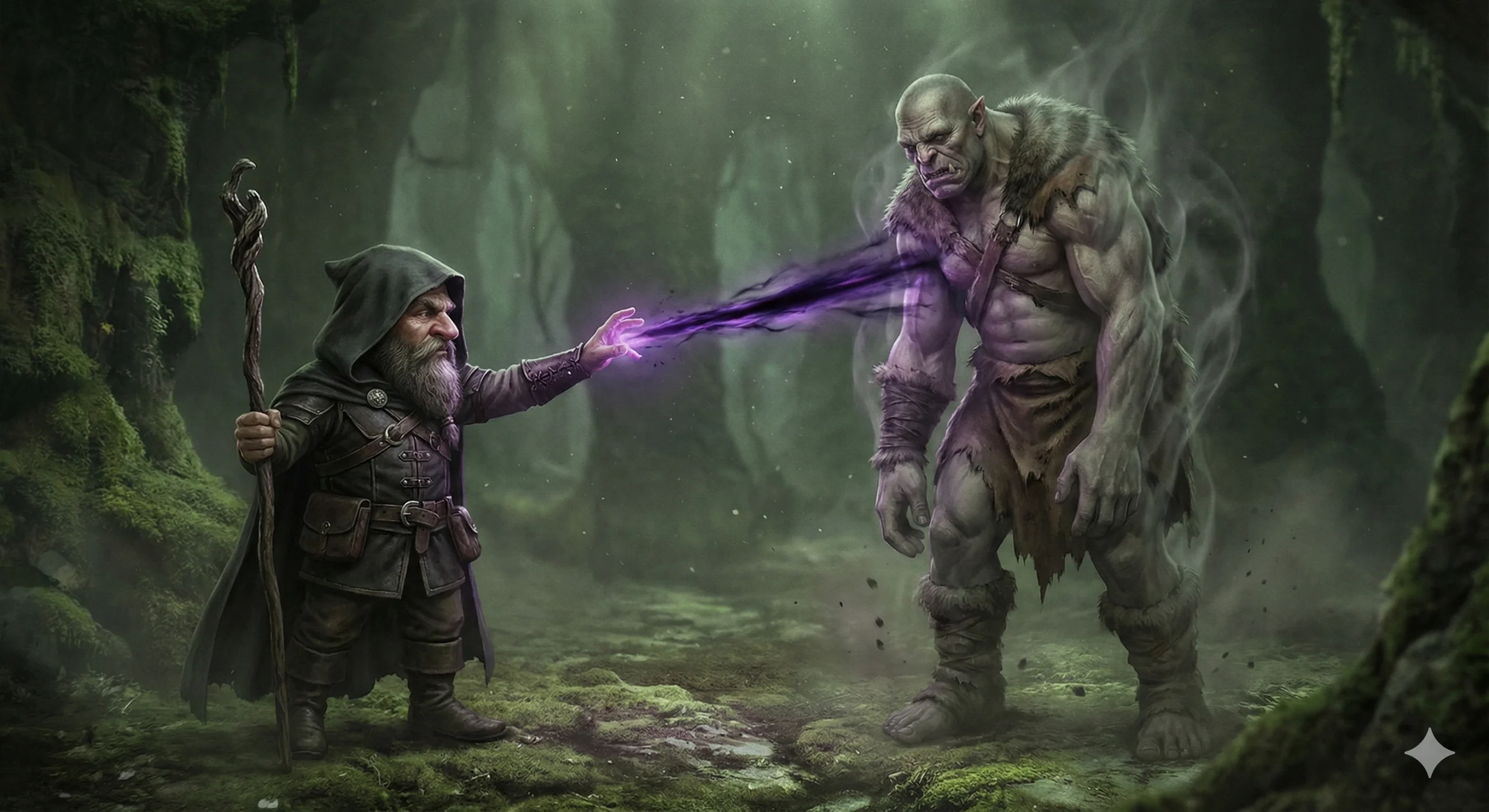
Ray of Enfeeblement forces a creature to make a Constitution saving throw. On a success, the creature suffers Disadvantage on the next attack roll it makes.
On a failed save, the creature suffers two distinct effects:
- Strength Debuff: It has Disadvantage on Strength-based D20 Tests (Ability Checks and Saving Throws).
- Damage Reduction: It subtracts 1d8 (average 4.5) from all its damage rolls.
The target repeats the save at the end of each of its turns, ending the effect on a success.
How did Ray of Enfeeblement change in the 2024 PHB?
The 2024 update overhauled the mechanics of Ray of Enfeeblement, changing how it hits, how it hurts, and what it does. The key changes are:
- Attack vs. Save: It is no longer a Ranged Spell Attack. It now requires a Constitution saving throw.
- Reliability (Save Success): In 2014, a miss did nothing. In 2024, a successful save still imposes Disadvantage on the target’s next attack roll.
- Damage Reduction Nerf: The 2014 version cut damage in half (scaling infinitely with the enemy’s power). The 2024 version subtracts a flat 1d8 damage. This is a significant nerf against high-damage monsters.
- Utility Buff: The spell now imposes Disadvantage on Strength-based D20 Tests (Ability Checks and Saves). This makes it an anti-grapple tool, though enemies can bypass this by using Dexterity.
Spell Rating: Ray of Enfeeblement
Overall: 🛡️ D-Tier (Situational Debuff)
Contextual Performance (1-10)
-
Combat: 3/10. The 2024 revision is reliable but weak. It guarantees an effect (Disadvantage on one attack) even on a successful save, but the “ceiling” of the spell has collapsed. Targeting Constitution saves is generally poor optimization, as big brutes (the target audience) usually have high Constitution modifiers.
The Math Problem (2014 vs. 2024):
Against a CR 5 Hill Giant (Greatclub: 18 damage):- 2014 Version: Reduces damage by 50% (9 damage prevented).
- 2024 Version: Reduces damage by 1d8 (4.5 damage prevented).
As monsters get bigger, the 2024 version gets worse at mitigation. Against a CR 10 Giant dealing 30 damage, the old version prevented 15 damage; the new version still only prevents 4.5. Ironically, with the 2024 version, you might actually prefer the target passes its save, as Disadvantage on one big attack is often more valuable than -1d8 damage.
-
Exploration: 1/10. No utility.
-
Social: 1/10. Theoretically useful for cheating at arm-wrestling or strongman competitions, but casting a visible necromancy beam usually starts a fight.
Core Metrics (1-10)
-
Raw Power: 2/10. The damage reduction (-1d8) is negligible past Level 5. While it helps against enemies with many small attacks, spells like Web or Hypnotic Pattern mitigate damage far more effectively by denying actions entirely.
-
Versatility: 3/10. The Disadvantage on Strength-based D20 Tests is useful, but easy to bypass. Agile enemies can simply choose to use Dexterity to escape Grapples, rendering this debuff useless against anyone but clumsy heavy-hitters.
-
Efficiency: 7/10. The “Effect on Save” mechanics make this efficient. Even if the boss passes the save, giving them Disadvantage on their next attack could negate a critical hit. It is rarely a “wasted” turn.
-
Upcast Scaling: 1/10. The spell does not scale with higher-level slots.
Playstyle and Synergy
-
Playstyle: Use this exclusively on “Brutes” (Giants, Ogres) with low AC and low Dexterity. Do not cast this on Rogues or Skirmishers.
-
Party Synergy: Moderate. It supports a Grappler build (Barbarian/Monk), but only against targets who aren’t Acrobatic. By imposing Disadvantage on Strength checks, you force the enemy to rely on their Dexterity; if their Dex is low, your ally’s Grapple becomes a lock.
Player Tip: The “Dexterity Loophole”
Before you cast Ray of Enfeeblement to help your Barbarian grapple a target, check the enemy’s archetype. The spell imposes Disadvantage on Strength-based D20 Tests.
However, the rules allow a creature to use Dexterity to resist or escape a grapple. If you cast this on a high-Dexterity enemy (like a Vampire or Assassin), they will simply ignore your debuff and flip out of the grapple using Acrobatics. Only use this spell on enemies who must use Strength (Ogres, Golems, and Heavy Armor users) or an otherwise bad Dexterity score.
What Are the Rules for Ray of Enfeeblement in 5e?
The rules for Ray of Enfeeblement in the 2024 Player’s Handbook are as follows:
-
Ray of Enfeeblement does not stack with itself. As per the general spellcasting rules, “the effects of the same spell cast multiple times don’t combine.” If two Wizards cast this on the same Ogre, the Ogre subtracts 1d8 damage, not 2d8.
-
Ray of Enfeeblement stacks with Resistance (Rage). The damage reduction from the spell happens before resistance is applied. An Ogre hitting a Raging Barbarian for 18 damage would first subtract 1d8 (e.g., 4) to 14, then halve it to 7.
-
The damage reduction applies to “all” damage rolls. The 2024 text states: “subtracts 1d8 from all its damage rolls.” Unlike the 2014 version, which specified Strength-based “weapon attacks,” this wording is broader (it also applies to spell attacks, funnily enough).
-
It affects Strength-based d20 rolls, not Dexterity. This is critical for target selection. An Ogre using a Greatclub (Strength) is a valid target. An Assassin using a Shortsword (Dexterity) is not. If you cast this on a Dexterity-based attacker, they will still subtract the 1d8 damage (if they fail the save), but they will not suffer Disadvantage on their attack rolls.
-
Legendary Resistance applies. In 2014, this spell required an attack roll, meaning Legendary Resistances didn’t help the boss. In 2024, it is a save-based spell. Regardless, though, the target has disadvantage on its next attack roll, even if it succeeds on the save with Legendary Resistance.
How Do I Use Ray of Enfeeblement in 5e?
Here are the optimized ways to utilize Ray of Enfeeblement under the 2024 rules:
-
Target multi-attackers. The damage reduction is a flat -1d8 per damage roll. This is mathematically superior against enemies who attack many times for low damage, rather than once for high damage. For example, against a Marilith (7 attacks), you prevent ~31.5 damage per turn.
-
The “Grapple Lock” on lox-Dex targets. If your party has a Grappler (Barbarian, Fighter, Monk), cast this on the target first. The target fails the save and suffers Disadvantage on Strength Checks. Your ally then grapples them. They’re now forced to use a weaker stat (Dexterity) to avoid being grappled/escape the grapple. This does nothing for you against high-Dex creatures though; they don’t care that you debuffed their Strength.
-
Negating crits. Even if the target succeeds on the save, they have Disadvantage on their “next attack roll.” If a Boss is winding up for a massive recharge attack (like a Bite or Tail sweep), casting this forces Disadvantage, drastically reducing the chance of a critical Hit.
Is Ray of Enfeeblement 5e a Good Spell?
No, Ray of Enfeeblement remains a suboptimal spell in DnD 5e, primarily because the math does not scale well into higher tiers of play.
-
The saving throw problem: The spell targets Constitution. Monsters that rely on Strength (Giants, Beasts, Monstrosities) almost universally have high Constitution scores. You are targeting their strongest defense.
-
The damage cap: In 2014, the spell halved damage. If a Dragon dealt 50 damage, you prevented 25. In 2024, you prevent 4.5. (Not like the 2014 version was good either – you were extremely unlikely to keep the debuff on an enemy you’d want to use it on for more than one turn). The defensive power of the spell has been capped, making it nearly useless in Tier 3 and Tier 4 play compared to control spells like Hypnotic Pattern or Fear, which prevent 100% of damage by denying actions.
Ray of Enfeeblement 5e DM Tips
The 2024 update actually implemented the “fix” many DMs used to homebrew (adding Disadvantage to Strength checks). However, the spell creates a specific rules interaction DMs need to watch out for: **Acrobatics vs. Athletics.**
Smart players will try to use this spell to “Lock Down” a boss. As a DM, remember that the Grapple rules allow a creature to use Dexterity (Acrobatics) or a Dexterity Saving Throw to avoid and escape a grapple.
If the party casts Ray of Enfeeblement on your nimble Boss (like a Vampire), do not forget that the boss can simply choose to use Dexterity to escape the grapple, bypassing the specific “Strength-based Disadvantage” the spell imposes. Reward the players when they use it on a sluggish Ogre, but don’t let it shut down your agile villains.
2014 Ray of Enfeeblement (Legacy Version)
The text below covers the version of Ray of Enfeeblement found in the 2014 Player’s Handbook. We have preserved this section for players running legacy campaigns or using older modules that haven’t updated to the 2024 rule set.
If you are playing with the 2024 rules, use the guide at the top of this page.
At the end of each of the target’s turns, it can make a Constitution saving throw against the spell. On a success, the spell ends.
Casting Time: 1 action
Range: 60 feet
Components: V, S
Duration: Concentration, up to 1 minute
School: 2nd-level necromancy

Matt Zane
Author, DnD Lounge